Applying to AdSense too early can waste time. Waiting forever is also not useful.
Use this checklist with AdSense Approval Checklist, use the next step with WordPress Categories, and keep Search Console for New Bloggers nearby before publishing or monetizing the site.
Where this fits in the abcnote stack
AdSense review is part of the site-quality cluster. It should connect content quality, mobile readability, Search Console measurement, image rules, and factual verification before monetization is even considered. Continue with these public abcnote guides: AI Fact-Checking, Tech Blog Image Rules, SEO and AEO Basics.
Quick answer: a tech blog is closer to AdSense-ready when it has original useful content, clean navigation, required trust pages, mobile-readable articles, safe images, clear sources, and no policy-risk monetization shortcuts.
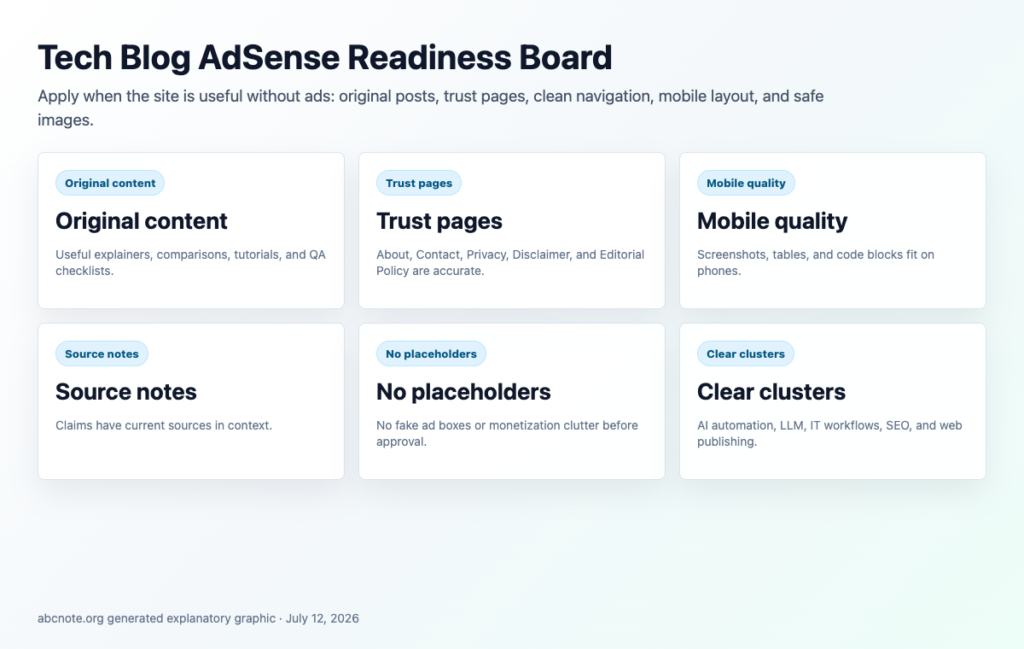
The wrong question
Many beginners ask, "How many posts do I need?"
A better question is: "Would a real reader trust this site if no ads existed?"
AdSense eligibility guidance emphasizes original, high-quality content that attracts an audience. That means the review is not only a post count. It is a site-quality check.
Tech blog readiness scorecard
| Area | Ready sign | Needs work |
|---|---|---|
| Original content | Posts explain, compare, guide, or verify something useful. | Generic AI summaries or copied topic coverage. |
| Topic focus | Clear clusters around AI, IT, automation, web publishing, or SEO. | Random categories with no site identity. |
| Trust pages | About, Contact, Privacy Policy, Disclaimer, and Editorial Policy are present and accurate. | Placeholder emails, fake phone numbers, or empty pages. |
| Navigation | Readers can find core categories and recent posts. | Too many empty categories or broken menu items. |
| Mobile layout | Images, tables, and code blocks fit on phones. | Screenshots overflow or captions appear before context. |
| Sources | Claims link to official or reliable sources in context. | Source dump at the end or no sources. |
| Safety | No exposed tokens, private screenshots, or unsafe commands. | Real secrets, account data, or risky automation steps. |
| Monetization | Keep the site clean before approval unless monetization is properly configured later. | Empty revenue boxes, fake promotional blocks, or misleading labels. |
Content quality checks
Review the first 20 to 30 posts manually.
Ask:
- Does each post answer why someone searched for the topic?
- Does each post give a concrete payoff?
- Are comparisons based on criteria readers care about?
- Do tutorials include steps, verification, and troubleshooting?
- Are AI claims fact-checked?
- Are screenshots useful and safe?
- Is there a clear cluster strategy?
A small useful library is better than a large thin one.
Site trust checks
Before applying, make sure the site does not look half-generated.
Check:
- site title and tagline are correct
- placeholder emails and phone numbers are removed
- About page explains the real site direction
- Contact page works or clearly lists contact method
- Privacy Policy matches actual tools in use
- Disclaimer does not make strange earnings promises
- Editorial Policy explains source checking and AI use honestly
For abcnote, the site direction should be practical AI automation, LLM tools, IT workflows, web publishing, SEO, analytics, and digital systems. It should not look like a narrow AdSense-only site.
Technical and layout checks
A tech blog often has screenshots, tables, and code. That creates extra review work.
Check:
- tables fit or scroll on mobile
- code blocks are readable
- command examples use placeholders
- body images are responsive
- the same image is not repeated as featured crop and body image
- the article does not duplicate the theme title as a body H1
- categories are real and not mostly empty
- sitemap and indexing basics are set up
Search Console is useful once connected because it shows which queries and pages are receiving impressions and clicks. Before there is enough data, manual review matters more.
AdSense readiness decision
Use this decision path:
- If required trust pages are missing, do not apply yet.
- If most posts are thin, revise before applying.
- If screenshots overflow or expose private data, fix images first.
- If navigation has empty categories or unfinished sections, clean it first.
- If content is useful but categories are imperfect, record the issue and decide whether it blocks trust.
- If the site has a clear topic identity, useful posts, clean pages, and mobile layout, prepare the application.
What not to add before approval
Do not add:
- fake monetization boxes
- empty revenue blocks
- promotional boxes with no real disclosure or purpose
- promotional-heavy sections
- income screenshots
- copied policy text that does not match the site
- AI-generated filler to increase post count
The goal is trust. Anything that makes the site feel like it was built only for monetization works against that.
Manual review checklist
Before applying, create a simple spreadsheet:
| Item | Pass/Fail | Notes |
|---|---|---|
| 25+ useful posts reviewed | ||
| About page accurate | ||
| Contact page accurate | ||
| Privacy Policy current | ||
| Editorial Policy current | ||
| Mobile screenshots checked | ||
| No empty monetization boxes | ||
| No duplicate title/H1 issue | ||
| Source notes present | ||
| Search Console connected |
Bottom line
AdSense readiness is not a trick. It is a quality review. A tech blog should apply when it looks useful without ads, reads cleanly on mobile, has trustworthy pages, and shows original work that real readers can use.
Last checked: July 12, 2026.
Review the site like a reader and a policy reviewer
A useful pre-AdSense review asks whether the site already helps real visitors. Check whether every article has a clear reader promise, original examples, source-backed claims, readable mobile layout, and a next step into related public pages.
For abcnote, the strongest signal is not article count. The site should show coherent clusters: AI automation, local AI, search and content quality, WordPress foundation, and home-lab setup. Use AI writing quality and AI fact-checking as core review articles before applying.
Keep monetization language modest. Do not promise approval, income, or clicks. The article should help the reader find fixable gaps: thin pages, weak navigation, missing policy pages, private draft links, duplicate images, and mobile tables that break on phones.
| Review area | Pass signal | Fix before applying |
| Content depth | Articles answer real setup, comparison, or checklist needs. | Expand thin pages with examples, source notes, and decision rules. |
| Navigation | Readers can move between related public articles. | Add contextual internal links and a final read-next block. |
| Trust pages | About, contact, privacy, and editorial/disclosure pages are easy to find. | Create or update missing pages before applying. |
| Mobile quality | Images and tables stay readable on phone width. | Use bordered tables, cards, or scroll wrappers. |
Final practical check before publishing
Read the first screen on a phone and confirm the visitor can see the main promise, the decision rule, and the next useful step without wading through vague background.
Recheck official documentation close to publication for pricing, policy, install, model, platform, and account-limit claims. For fast-moving AI and search topics, explain the decision method instead of pretending one snapshot will stay accurate forever.
Keep the article connected to abcnote clusters through contextual links in the body, then use the final read-next block as a reader-facing path to related public guides.
AdSense Blog Review final checks
AdSense Blog Review should improve reader trust before it tries to improve rankings. Confirm the official source, keep the user-facing promise narrow, and remove anything that looks like a private planning note instead of public advice.
For current details, review Google AdSense eligibility requirements. Documentation, pricing pages, eligibility language, and product screens can change, so the final draft should match current source pages instead of relying only on old screenshots.
| Check | What to verify | Why it matters |
| Article quality | Check length, originality, source links, headings, and reader payoff. | A review-ready blog needs useful pages, not filler. |
| Visual quality | Confirm images explain the topic and fit mobile screens. | Broken visuals make a new site feel unfinished. |
| Link path | Use contextual internal links plus a read-next block. | Readers should continue naturally after the first article. |
AdSense Blog Review: final evidence before you apply
AdSense Blog Review work should finish with evidence a reviewer can see without guessing. A new blog does not need to look like a magazine, but it does need a clear topic, original explanations, useful navigation, policy-safe pages, working links, and enough public value that the article is not just a keyword shell. Before submitting the site, connect the review page to the AdSense Approval Checklist, the AI Writing Without Thin Content, and the Search Console for New Bloggers so the reader can move from readiness checks to real indexing signals.
The most common failure is not one dramatic violation. It is a collection of small trust gaps: pages with no author context, articles that repeat generic AI advice, thin comparison posts with no source links, screenshots without alt text, and categories that make the site feel random. Fix those before applying. A stronger AdSense Blog Review asks whether every important post has a specific reader problem, a first-screen answer, source-backed details, and a path to another relevant article. Google explains the broad quality expectation in its AdSense eligibility guidance and its AdSense program policies; use those pages as the baseline, not forum rumors.
| Review area | Pass signal | Fix before applying |
| Content depth | Core articles answer real questions with examples, sources, images, and internal links. | Expand thin posts and remove generic filler before asking Google to review the site. |
| Site trust | About, contact, privacy, navigation, categories, and author context are easy to find. | Do not hide basic ownership and policy pages behind unclear menus. |
| Search evidence | Search Console shows crawl/index signals and the sitemap is submitted. | Use Search Console for New Bloggers to check indexing before treating the site as ready. |
AdSense Blog Review source checks
Use a short source ladder for the final pass. For policy and eligibility, use official Google Help pages. For SEO and helpful-content structure, use Google Search Central helpful content guidance. For screenshots and article evidence, keep the image rules in Tech Blog Screenshot Rules close by. If a claim cannot be tied to an official page, a reputable source, or your own clearly labeled experience, either rewrite it as a cautious practical recommendation or remove it.