Quick answer: Samsung physical AI robotics is worth watching because it moves AI from chat windows into machines that sense rooms, move through space, and interact with appliances, factories, and people. It does not mean most families should rush to buy a humanoid robot. The smart move is to watch the platform, safety, privacy, repair, and smart-home integration pieces before treating home robots like ordinary appliances.
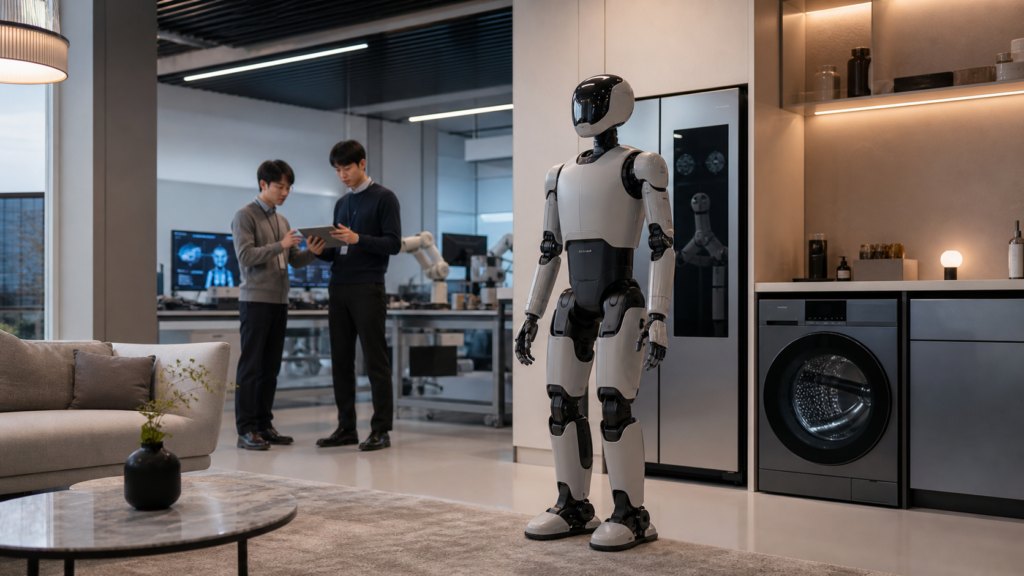
Samsung’s interest in robotics provides a useful starting point for exploring physical AI: systems that connect perception, planning, and movement in real-world environments. Company-specific organization and product announcements should be checked against dated official disclosures before drawing conclusions about launch schedules. Current coverage frames the move around humanoid robots, home robots, industrial automation, and Samsung’s broader AI hardware strategy. For abcnote readers, the useful question is not whether a robot headline is exciting. The useful question is what has to become true before a robot in a home, office, school, hotel, hospital, or factory becomes dependable enough to matter.
Physical AI is different from a chatbot because the output is not only text. A physical AI system may move an arm, open a door, follow a person, carry an object, inspect a machine, map a room, or coordinate with a washer, refrigerator, phone, camera, lock, or cloud service. That raises a higher bar. A bad chatbot answer is annoying. A bad robot action can break an object, scare a child, block a hallway, expose a camera feed, or create a safety problem.
That is why this guide treats the Samsung robotics push as a practical decision map. It explains the trend, the likely product paths, the buyer questions, the smart-home consequences, the privacy risks, and the signals that would make the category feel real instead of hype.
Samsung physical AI robotics in one minute
| Reader question | Short answer | Why it matters |
|---|---|---|
| What changed? | Current news coverage says Samsung has moved robotics into a more dedicated strategic structure. | A dedicated division usually means more focus, hiring, product planning, and long-term platform work. |
| What is physical AI? | AI that controls or assists machines operating in physical spaces. | Robots need sensors, motors, maps, safety limits, and reliable behavior, not just language output. |
| Is this only humanoid robots? | No. Humanoids get attention, but appliances, service robots, warehouse robots, factory robots, and smart-home systems matter too. | The first useful products may be narrower than the headline image of a human-shaped helper. |
| Should buyers wait? | Most ordinary buyers should watch, not rush. | The category needs proof on price, usefulness, safety, repair, privacy, and software support. |
| Where does Samsung have an edge? | Devices, chips, displays, appliances, phones, SmartThings, and manufacturing scale. | Robots become more valuable when they connect to the rest of the environment. |
| What is the risk? | Overpromising, privacy surprises, unsafe movement, short software life, and weak real-world usefulness. | Robots fail in more visible ways than apps. |
Why this topic is bigger than one Samsung headline
The robotics industry has been growing for years, especially in manufacturing and logistics. The International Federation of Robotics regularly tracks robot sales and industrial adoption, which is a useful reminder that the most mature robot markets are not the fantasy version of a robot but specific machines doing repeatable work. Physical AI becomes interesting because it may make robots more flexible, easier to train, and more aware of changing environments.
Samsung’s angle matters because the company already touches many parts of daily technology: phones, displays, memory, chips, TVs, appliances, smart-home software, and manufacturing. A robot that works with appliances, sensors, mobile devices, and local/cloud AI may be more useful than a standalone robot that has no ecosystem. That ecosystem logic is why smart-home network choices and device interoperability matter for this trend.
There is also a Korea technology angle. Samsung is one of the companies people already associate with Korean electronics, AI hardware, and consumer devices. A robotics division can become a signal that physical AI is moving from research demos into product roadmaps. But readers should be careful: a roadmap is not the same as a finished product, and a humanoid video is not the same as a safe household appliance.
What physical AI means in plain English
A chatbot predicts and generates language. A physical AI robot must understand a room, estimate distance, detect people, avoid obstacles, choose actions, control motors, recover from mistakes, and obey limits. It may use computer vision, speech recognition, mapping, sensor fusion, motion planning, edge AI, cloud AI, and human approval. The more it touches the real world, the more every small error matters.
A useful home robot has to answer very practical questions. Can it move on carpet? Can it avoid stairs? Can it understand a dark hallway? Can it distinguish a child, pet, cable, sock, glass, chair leg, and wet floor? Can it work when Wi-Fi is weak? Can it pause safely when confused? Can a family member stop it quickly? Can it explain what it did? Can it avoid sending private camera data to the wrong place?
This is why physical AI needs a trust stack. NIST AI resources are useful here because they frame AI risk as a governance, measurement, and reliability problem, not only an innovation problem. NIST Cybersecurity Framework resources also matter because robots and smart-home systems are networked devices. A robot that can see, hear, move, and connect to accounts needs stronger security habits than a simple Bluetooth speaker.
The four likely product paths
1. Home companion and helper robots
This is the headline-friendly category: a robot that moves around a home, answers questions, follows a person, reminds users about tasks, checks appliances, or helps with simple routines. Samsung has already shown interest in AI in the home through SmartThings and AI-enabled appliances, so a future robot could become a mobile interface for the smart home.
The challenge is usefulness. A robot that can only talk is competing with phones, smart speakers, tablets, and TVs. A robot that can physically help needs reliable mobility, manipulation, battery life, object handling, and safe behavior around people. Most buyers should ask what task the robot performs better than a phone plus a smart-home routine.
2. Appliance-connected robots and ambient AI
A less dramatic but more realistic path is appliance-connected AI. Instead of one humanoid doing everything, the home may get smarter through appliances, sensors, screens, and small mobile devices that coordinate. Samsung SmartThings is relevant because smart-home automation depends on connected devices, rules, scenes, notifications, and account control.
This path may produce useful features sooner: a robot or mobile device checking whether the washer is finished, noticing a door was left open, guiding a cleaning routine, or helping a family member manage home devices. It is not as viral as a humanoid robot, but it may solve real problems faster.
3. Factory, logistics, and industrial robots
Industrial robotics is where the business case is often clearer. Factories and warehouses can justify robots when they improve safety, consistency, speed, or labor allocation. Samsung’s manufacturing background matters here. A company that builds complex electronics at scale understands production lines, quality control, sensors, and automation economics.
Physical AI could make industrial robots more adaptable, but industrial customers will still demand uptime, integration, support contracts, safety compliance, and measurable return on investment. This is a different world from consumer gadgets. It is slower, stricter, and less forgiving, but it can be commercially stronger.
4. Education and robotics learning
There is a useful bridge to education. When students use platforms like VEX or LEGO SPIKE, they learn that robots are not magic. They learn sensors, motors, coding, iteration, and debugging. abcnote’s VEX or LEGO SPIKE guide explains that robotics education is valuable because it turns code into physical consequences. That same idea applies to Samsung’s physical AI push at a much larger scale.
Parents and schools should not read a Samsung robotics headline as a reason to buy expensive equipment immediately. But it is a reason to treat robotics, mechanics, sensors, AI, and hands-on building as durable skills. The future robot industry will need people who understand software and hardware together.
Buyer checklist before believing the home robot hype
| Checklist item | What to ask | Why it matters |
|---|---|---|
| Price/cost | What is the device price, subscription cost, repair cost, battery replacement cost, and accessory cost? | A home robot can become expensive if the useful features require cloud services or proprietary parts. |
| Supported platform | Does it work with Android, iOS, SmartThings, Matter, Wi-Fi, Bluetooth, and existing appliances? | A robot that does not connect to the household ecosystem becomes a novelty device. |
| Hardware requirements | What sensors, cameras, microphones, battery, compute, and docking setup does it use? | Hardware limits define what the robot can actually do safely. |
| Setup difficulty | Can an ordinary family set zones, permissions, accounts, maps, and emergency stop behavior? | A hard setup creates unsafe defaults and abandoned devices. |
| Privacy/security | Where do video, audio, maps, voice commands, and account tokens go? | Robots may collect more sensitive home data than normal appliances. |
| Performance | Can it handle pets, children, clutter, low light, carpets, stairs, and network outages? | Real homes are messier than demo rooms. |
| Repair and support | How long are software updates promised, and who fixes motors, sensors, wheels, arms, and batteries? | Physical products need support after the launch excitement fades. |
| Best use case | What job does it do better than a phone, speaker, camera, appliance, or robot vacuum? | If the answer is vague, wait. |
Smart-home impact: the robot is only as good as the house
A future home robot will depend on the home around it. If the Wi-Fi is unstable, accounts are messy, device names are confusing, automations are brittle, and family permissions are unclear, the robot will inherit that mess. This is why a physical AI robot should be viewed as the top of a stack, not the foundation.
The stack starts with reliable networking, device naming, secure accounts, and clear automation rules. A smart-home robot should know which devices it can control, which rooms are private, which actions need approval, and what to do when the internet fails. The Wi-Fi 7 vs 6E smart home guide is relevant because robot reliability depends on boring infrastructure: coverage, latency, interference, and device capacity.
Local control also matters. Some AI tasks can run locally, while others may need cloud models. abcnote’s local AI hardware guide explains the RAM, VRAM, and model-size tradeoffs behind local AI. Robots add another layer: local processing can reduce latency and privacy exposure, but powerful perception and language features may still lean on cloud services.
Privacy: the camera is not just a camera anymore
A robot camera is different from a doorbell camera. It may move through bedrooms, kitchens, offices, living rooms, and hallways. It may map furniture, recognize faces, hear voices, and infer routines. That makes privacy one of the first buyer questions, not an afterthought.
Before buying any physical AI device, check whether video and audio are processed locally, sent to cloud servers, used for model improvement, retained for troubleshooting, shared with third parties, or available to other household members. Samsung’s public digital responsibility pages are useful as a starting point, but buyers should still read the product-specific privacy terms when a real device ships.
The practical rule is the same one abcnote uses for cloud AI: do not put sensitive data into a system until you understand the account, retention, training, export, deletion, and admin controls. The cloud AI privacy checklist gives the same habit in a software context. Physical AI makes that habit more urgent because the data may come from inside the home.
Security: a robot should not become the weakest account in the house
If a robot can unlock routines, view cameras, speak through speakers, interact with appliances, or connect to a cloud account, it becomes part of the household security boundary. Buyers should expect strong account protection, multi-factor authentication, passkeys where supported, regular firmware updates, clear permission controls, and a way to remove the device from the account before resale or repair.
The NIST Cybersecurity Framework is designed for organizations, but the core ideas still help ordinary buyers think clearly: identify assets, protect access, detect problems, respond to incidents, and recover. In home terms, that means knowing which account controls the robot, which devices it can access, how updates happen, what logs exist, and how to disable it quickly.
For account hygiene, the passkeys or password managers guide is a useful next step. A robot with a weak reused password is not futuristic. It is just another exposed smart-home device.
Jobs and skills: what physical AI may change
Physical AI can affect factories, logistics, elder care, hotels, hospitals, retail, schools, and homes. The job impact will not be one simple story. Some tasks may be automated. Some jobs may become safer or less repetitive. Some workers may need to learn robot supervision, maintenance, process design, safety checks, and exception handling.
For students, the signal is clear: robotics is no longer only a club activity. Mechanical reasoning, coding, sensors, AI literacy, electronics, safety thinking, and debugging are becoming practical career skills. That does not mean every child needs a humanoid robot. It means hands-on STEM and hardware projects are more valuable when they teach how software changes physical behavior.
For small businesses, the better question is not ‘Will robots replace people?’ It is ‘Which repeated physical tasks are painful, measurable, and safe enough to automate?’ A restaurant, clinic, warehouse, or hotel may benefit from narrow robots long before a general humanoid helper is worth the price.
What would make Samsung’s robotics push credible?
- A specific task: The product should solve a clear job, not just move around and answer questions.
- Safe behavior: It should stop, yield, and recover gracefully around people, pets, clutter, stairs, and fragile objects.
- SmartThings integration: It should improve the smart-home system instead of becoming another isolated app.
- Transparent privacy controls: Buyers should know what is processed locally, what goes to the cloud, and how to delete data.
- Long software support: A robot should not become obsolete after a short update cycle.
- Repair path: Motors, sensors, batteries, wheels, arms, and docks need realistic support.
- Real demos in messy spaces: A product should work in ordinary homes or workplaces, not only on a spotless stage.
Mistakes to avoid when reading robot news
Mistake 1: treating a division as a finished product
A dedicated robotics division is important, but it is not the same as a robot that ordinary buyers can purchase, maintain, and trust. Watch for product details, support terms, safety evidence, and real-world demos.
Mistake 2: assuming humanoid shape means human usefulness
A humanoid robot may be useful in spaces designed for people, but a non-humanoid machine can be better for many jobs. Robot vacuums, factory arms, delivery robots, and inspection robots prove that useful robots often have specialized shapes.
Mistake 3: ignoring the home infrastructure
A robot depends on Wi-Fi, accounts, device names, permissions, maps, batteries, and user habits. If the smart home is disorganized, the robot will not magically fix it.
Mistake 4: accepting vague AI claims
Ask what the AI actually does. Does it recognize objects? Plan routes? Predict maintenance? Understand commands? Control appliances? Detect falls? Summarize alerts? Different AI claims have different value and risk.
Mistake 5: forgetting privacy before the first setup
Privacy settings are easiest to decide before a device starts mapping rooms and syncing accounts. Read the data controls, disable unnecessary sharing, and avoid connecting sensitive accounts until the product proves itself.
Best reader decisions right now
| Reader type | Best action now | Reason |
|---|---|---|
| Smart-home buyer | Improve Wi-Fi, account security, device naming, and automations before buying a future robot. | A reliable home stack will matter more than the first robot demo. |
| Parent or student | Use robotics kits, coding projects, and hardware builds to learn sensors and iteration. | Physical AI rewards people who understand both software and mechanics. |
| Small business owner | List repeated physical tasks, safety constraints, and labor pain points. | Narrow automation opportunities are easier to evaluate than general robot promises. |
| Privacy-sensitive household | Avoid always-on mobile cameras until product-specific privacy terms are clear. | Moving sensors create more sensitive data than stationary devices. |
| Investor or tech watcher | Track product milestones, partnerships, support terms, and manufacturing signals. | A division announcement is only the first signal. |
Source notes and date checked
Sources were checked on July 22, 2026. Current Samsung robotics coverage is still developing, so this article avoids claiming that a specific consumer robot is ready to buy unless Samsung officially launches it. The stable source links below support the broader context around SmartThings, digital responsibility, AI risk, cybersecurity, robotics market data, and robotics coverage.
- Google News: Samsung robotics division physical AI coverage
- Samsung SmartThings official page
- Samsung digital responsibility
- NIST Artificial Intelligence resources
- NIST Cybersecurity Framework
- International Federation of Robotics press releases and robot statistics
- IEEE Spectrum robotics coverage
- ISO robotics standards landing page
Bottom line: watch the platform, not just the robot
Samsung’s physical AI robotics push is interesting because Samsung already has devices, appliances, chips, displays, smart-home software, manufacturing scale, and consumer reach. That gives the company a credible path into robots that connect with the rest of daily technology.
But the useful consumer answer is cautious. Do not buy the hype before the job is clear. The winning home robot will not be the one with the most dramatic launch video. It will be the one that safely solves a repeated problem, respects privacy, receives updates, integrates with the home, and remains repairable after the novelty fades.
For abcnote readers, the practical move is to learn the stack now: robotics basics, local AI limits, smart-home infrastructure, account security, privacy controls, and automation QA. That preparation will matter whether Samsung, another electronics company, or a specialized robotics firm ships the first truly useful physical AI device for ordinary homes.
A demo becomes a deployment question at the first interruption
Imagine a robot demonstrating a tidy delivery route. Ask what happens if a person steps into its path, an item is missing, or the network disconnects. These questions reveal the distance between a presentation and an operating process.
| Situation | Next check | Why it changes the decision |
|---|---|---|
| Person blocks the route | Request the documented stop and recovery behavior. | Smooth movement in an empty space is insufficient. |
| Task cannot be completed | Ask how the operator is notified and takes over. | A stuck robot needs an accountable recovery path. |
| Vendor promises a future feature | Separate available capability from the roadmap. | A purchasing decision should not rely on an undelivered promise. |
This is an evaluation brief, not a report that a Samsung product passed or failed. Keep prototype, announced product, shipping configuration, and operational evidence in separate categories.