Quick answer: the practical VEX IQ vs VEX V5 choice is not about which system is more impressive. VEX IQ is usually the better first VEX kit for elementary and middle-school learners who need fast wins, lower build friction, safer parts handling, and a gentler bridge into coding. VEX V5 is the better fit for older middle-school students, high-school students, competition teams, and hands-on builders who are ready for larger metal robots, more hardware discipline, deeper engineering tradeoffs, and a higher budget.
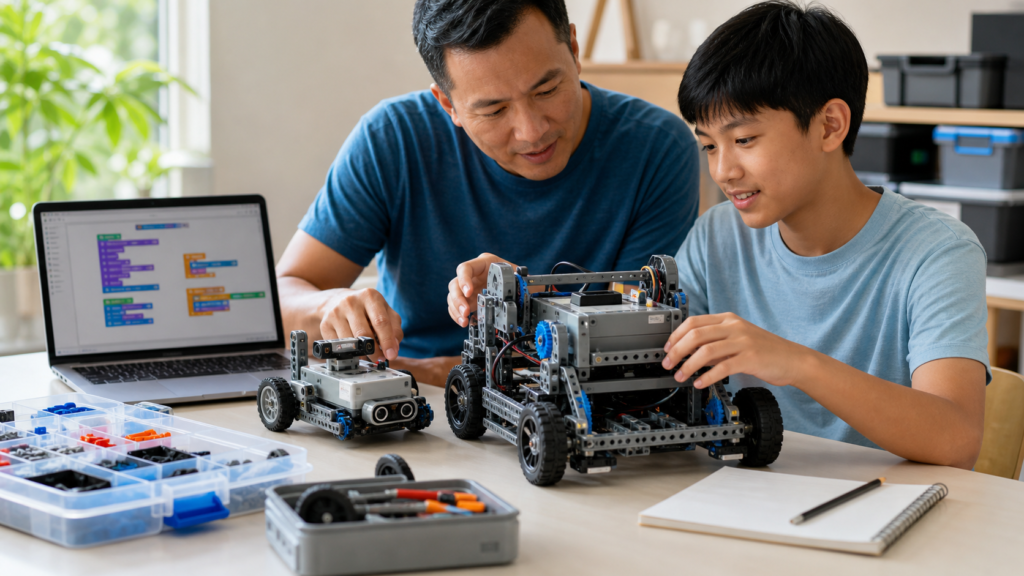
Parents often arrive at this decision after a child shows interest in robotics, a school club mentions VEX, or a family compares VEX with LEGO SPIKE. abcnote already has a broader VEX or LEGO SPIKE robotics kit guide; this article answers the next, more specific question: if the family wants to stay inside the VEX ecosystem, should the child start with VEX IQ or jump to VEX V5?
The short version is simple. Choose VEX IQ when the goal is confidence, classroom-friendly building, quick programming feedback, and age-appropriate robotics habits. Choose VEX V5 when the student already likes mechanical problem-solving, can tolerate troubleshooting, wants a serious competition path, and has enough adult or team support to manage cost, parts, storage, tools, and practice time. A motivated younger student can grow fast, but buying the more advanced platform too early can turn excitement into frustration.
This guide is written for parents, coaches, homeschool families, and school-club organizers who need a buying decision, not just a product brochure. It compares learning curve, age fit, coding, mechanical complexity, competition path, cost, safety, storage, upgrade timing, and the kind of child who is likely to enjoy each system. It also connects robotics learning to AI, automation, local computing, and practical STEM skills; a robotics kid who loves sensors and code may later enjoy abcnote’s Samsung physical AI robotics guide or local AI workflow guide.
VEX IQ vs VEX V5 in one minute
| Decision point | VEX IQ | VEX V5 |
|---|---|---|
| Best starting age | Usually better for elementary and middle-school entry, depending on maturity and support | Usually better for older middle school, high school, and serious competition teams |
| Build feel | Plastic snap-together system, faster iteration, lower tool friction | Metal structure, screws, shafts, motors, more engineering discipline |
| Coding path | Friendly path through VEXcode Blocks and text options as students grow | Stronger fit for students ready to think through sensors, autonomous routines, driver control, and more advanced code |
| Competition path | Good first competition environment for younger robotics students | Stronger long-term path for high-school robotics teams and advanced builders |
| Parent workload | Lower at home because setup, storage, and repairs are simpler | Higher because parts management, tools, practice field needs, and troubleshooting take more time |
| Budget pressure | Generally lower total pressure for a first family kit | Higher total pressure once you include parts, batteries, chargers, field elements, tools, and team needs |
| Best fit | Curious child who needs early wins and structured learning | Persistent builder who enjoys debugging and mechanical iteration |
What VEX IQ is best for
VEX IQ is the better default when the child is new to robotics or when the adult support system is still forming. The plastic build system makes early robot construction less intimidating. Students can assemble a drivetrain, attach sensors, test a mechanism, and change parts without turning the first project into a hardware-management job. That matters because early robotics motivation comes from seeing a robot move, fail, improve, and move again.
A strong VEX IQ experience teaches the core loop: build, code, test, observe, revise. That loop matters more than the size of the robot. A student learns gear ratios, sensor placement, turning accuracy, autonomous movement, teamwork, documentation, and competition strategy without needing the full weight of a V5-style metal platform. For many families, that is the correct first step.
VEX IQ is also easier for a parent to support at home. Parts are less intimidating, storage is simpler, tools are lighter, and mistakes are easier to unwind. If a child loses interest after a few weeks, the sunk cost and space burden are usually less painful than starting with a larger competition platform. If the child becomes obsessed, VEX IQ still gives a real foundation that transfers to VEX V5 later.
Choose VEX IQ if
Your child is still learning patience, likes fast results, wants to build at home, or needs a robotics start that feels more like discovery than a varsity engineering project.
Be careful if
The student is already a strong mechanical tinkerer who gets bored by simplified parts and wants larger structures, stronger motors, and more open-ended engineering decisions.
Parent benefit
The family can focus on habits: naming parts, charging batteries, saving code, testing one change at a time, and cleaning up after each build session.
Learning win
Students can reach the important robotics feedback loop quickly: I built it, I coded it, it moved, it failed, and I improved it.
What VEX V5 is best for
VEX V5 is the more serious platform. It rewards students who like mechanical systems, competition constraints, driver practice, autonomous routines, sensor tuning, and iterative design. The robots can be larger, stronger, and more mechanically expressive. That is exciting for the right student and exhausting for the wrong one.
A V5 robot teaches lessons that feel closer to high-school engineering: structural rigidity, weight, torque, battery management, motor limits, wiring, repair discipline, team roles, strategy, notebook habits, and code that must work under pressure. A student who already loves building, 3D printing, bike repair, RC cars, or mechanical troubleshooting may light up when V5 gives them a more serious machine to improve.
The tradeoff is support. VEX V5 costs more, takes more space, and usually benefits from a school team, club, mentor, or parent who can tolerate parts management. A family can buy pieces for home use, but the platform makes the most sense when there is enough structure to keep the student from drowning in options. Bigger does not automatically mean better. It means the student needs more persistence and the adults need a more realistic plan.
Age fit is not just age
Age recommendations are useful, but they are not the whole decision. Some younger students have unusual patience and mechanical confidence. Some older students prefer quick creative coding and do not enjoy long mechanical builds. The better test is not birthday age; it is frustration tolerance, fine-motor comfort, interest in tools, willingness to document changes, and whether the child comes back after a failed test.
A child ready for VEX V5 usually does not only say, “I want the bigger robot.” They show signs of process interest. They ask why a mechanism jammed. They compare wheel choices. They want to adjust code after a failed run. They can spend a Saturday improving one subsystem instead of expecting a finished toy. If that sounds miserable, VEX IQ is likely the healthier start.
| Student signal | Better first match | Why |
|---|---|---|
| Wants a robot to move quickly on day one | VEX IQ | Early visible success keeps motivation alive. |
| Already repairs bikes, builds mechanisms, or likes tools | VEX V5 may fit | Mechanical patience matters more than age alone. |
| Gets angry when a build fails | VEX IQ | Lower-friction iteration teaches persistence gently. |
| Enjoys competitions, practice, and team roles | VEX V5 may fit | The platform rewards repeated tuning and strategy. |
| Mostly wants to learn coding | VEX IQ first or software-first path | Robot hardware should not block the coding habit. |
| Wants a school-team challenge | Depends on the team level | Follow the actual team platform and coach plan. |
Coding: blocks, Python, C++, and the real learning path
VEXcode is one of the reasons VEX can work well as a learning ecosystem. Students can begin with block-based programming and move toward text coding as they mature. Parents should not treat block coding as childish. Blocks can teach sequencing, loops, conditions, sensor logic, and debugging without syntax errors consuming every lesson. Text coding becomes useful when the student is ready to think about structure and details at the same time.
VEX IQ is often better when coding confidence is still fragile. A student can make the robot drive, turn, react to sensors, and complete simple challenges with less mechanical overhead. VEX V5 becomes more interesting when the robot itself demands deeper code: autonomous paths, driver-control tuning, sensor fusion, motor groups, competition templates, and repeated testing. That depth is valuable, but only when the student can handle it.
For parents thinking beyond robotics, the coding mindset matters more than a single language. A child who learns to debug a robot can later understand why AI workflows need test cases, why local models need hardware constraints, and why automation needs safety checks. That is the same practical bridge abcnote covers in the local AI tools guide, Python environment guide, and AI automation concepts guide.
Competition path: VEX IQ Competition vs VEX Robotics Competition
Competition changes the buying decision. If the child is joining an existing school or community team, start with the team’s platform. A VEX IQ team and a VEX V5 team have different parts, fields, game manuals, build expectations, practice rhythms, and mentor needs. Buying the wrong home kit can still be educational, but it may not help the actual team season.
VEX IQ Robotics Competition is generally the friendlier first competition path for younger students. It still teaches teamwork, game analysis, autonomous scoring, driver practice, and iterative engineering. VEX Robotics Competition with V5 is a larger step. It can be fantastic for high-school students, but it asks for more time, deeper mechanical thinking, stronger team organization, and usually more money.
Parents should ask the coach or club three practical questions before buying: what platform does the team use this season, what parts are students allowed to bring or practice with at home, and what skills should the child develop between meetings? A home kit is most useful when it matches the team’s learning goals rather than becoming a separate pile of parts.
Cost: compare the whole robotics habit, not just the starter kit
The price tag of a starter kit is only part of the budget. Robotics creates supporting costs: storage bins, spare parts, batteries, chargers, tools, replacement pieces, competition fees, travel, shirts, field elements, practice space, and adult time. VEX V5 usually creates more total budget pressure because the robots are larger and competition ambitions can grow quickly.
That does not mean VEX V5 is wasteful. For the right student, V5 can be a serious STEM investment. The point is to buy it with eyes open. If the family has no table space, no storage habit, no coach, and no plan for troubleshooting, V5 can sit unused. If the child is already deeply engaged, a well-supported V5 path can teach more than many passive classes.
| Budget item | VEX IQ pressure | VEX V5 pressure |
|---|---|---|
| Starter kit | Usually easier to justify as an entry point | Higher commitment and easier to underbuy for serious use |
| Storage | Moderate bins and part sorting | More bins, larger parts, more careful inventory |
| Tools | Lower tool friction | More tool discipline and replacement hardware |
| Practice field | Helpful but more manageable | More space pressure if competition practice becomes serious |
| Replacement parts | Still needed, but mistakes are less intimidating | More important because hard testing can bend, loosen, or wear parts |
| Adult time | Can be guided casually at first | Works better with coach, mentor, or highly engaged parent |
Safety, storage, and home reality
Robotics is one of the best ways to turn screen interest into hands-on learning, but it still needs house rules. Batteries should be charged safely. Small parts should be kept away from younger siblings. Tools should have a home. Builds should not take over the dining table forever. Code and project files should be saved in a predictable place. Students should learn cleanup as part of engineering, not as a punishment after engineering.
VEX IQ makes this easier because the platform is lighter and more home-friendly. VEX V5 requires more maturity. Metal parts, screws, shafts, wiring, motors, and larger robots make organization more important. If the child cannot yet keep parts sorted, V5 may turn the parent into the unpaid parts manager. That can drain the fun quickly.
Digital safety matters too. Students may create accounts, download coding tools, search tutorials, watch build videos, and share team files. Use official downloads and documentation where possible. Avoid random installer mirrors, suspicious project files, and unnecessary account sharing. Basic account hygiene from abcnote’s security articles applies to STEM learning as much as it applies to work tools.
Which child should start with VEX IQ?
- The child is curious but not yet mechanically patient.
- The family wants a first robotics kit that can produce visible wins quickly.
- The student is in elementary or early middle school and needs age-appropriate build friction.
- The parent or coach wants to teach engineering habits without a large tool-and-parts burden.
- The child’s school, camp, or club uses VEX IQ.
- The student likes coding, sensors, and challenges but may not enjoy long mechanical repairs yet.
- The family wants to test interest before committing to a larger VEX V5 path.
Which child should start with VEX V5?
- The student already likes mechanical projects and comes back after failed tests.
- The student is joining a VEX V5 school team or competition program.
- The family has enough space, budget, and adult support for a larger platform.
- The student wants stronger motors, metal builds, deeper coding, and serious driver practice.
- The student can sort parts, follow safety rules, and document changes.
- The goal is high-school competition readiness rather than a gentle first robotics taste.
- The child is motivated by engineering tradeoffs, not only by a finished robot.
A sensible upgrade path
Many families should think in stages. Start with VEX IQ or a school-friendly entry path. Build two or three small projects. Try a simple autonomous challenge. Let the child experience both success and failure. If the child keeps asking for more, joins a team, watches competition strategy, and wants to build stronger mechanisms, then VEX V5 becomes a natural next step.
The upgrade path should be earned by behavior, not promised as a reward for one weekend of excitement. Robotics interest is real when a student returns to the robot after it fails. Parents can watch for that. Does the child ask to test again? Do they want to change one variable? Do they remember where the parts go? Do they get curious about code instead of only wanting the robot to look cool? Those signs matter.
Stage 1
Try structured robotics through school, camp, VEX IQ, LEGO SPIKE, or a small challenge. The goal is to learn the build-code-test loop.
Stage 2
Add sensors, autonomous movement, simple notebooks, and practice challenges. The student should learn to explain what changed and why.
Stage 3
Join a team or club if competition motivates the student. Match the home kit to the team’s actual platform.
Stage 4
Move to VEX V5 when the child wants deeper mechanical work and the support system can handle the larger commitment.
Parent questions before buying
| Question | Why it matters | What to do |
|---|---|---|
| Does my child want building, coding, competition, or all three? | Different motivations point to different platforms | Ask the child to rank the fun parts after watching a real build or match. |
| Is there a local team, school club, or mentor? | V5 especially benefits from structure | Contact the coach before buying expensive parts. |
| Can we store and maintain the kit? | Lost parts and dead batteries ruin momentum | Buy bins and make cleanup part of the routine. |
| What is the real budget after the starter kit? | Robotics costs grow through parts and practice | Set a first-season budget and avoid impulse upgrades. |
| Will the child tolerate debugging? | Robotics is controlled frustration | Start smaller if failure causes shutdown rather than curiosity. |
| Can the kit connect to future interests? | Robotics can lead to Python, AI, automation, hardware, or engineering | Choose projects that teach transferable habits, not only trophy goals. |
Common buying traps
Buying VEX V5 because it looks more serious
A bigger robot can look more impressive, but it may be the wrong first tool. Serious learning starts when the student can complete the feedback loop. If V5 makes the first loop too hard, VEX IQ may teach more in the first month.
Buying VEX IQ when the student needs a harder mechanical challenge
Some students are ready for metal, tools, and deeper engineering. If a teenager already builds mechanical projects and wants competition-level work, VEX IQ may feel too constrained. The right platform should stretch the student without burying them.
Ignoring the local team platform
A home kit should support the real learning environment. If the school uses VEX V5, ask what home practice helps. If the club uses VEX IQ, do not assume V5 will make the child more prepared. Team alignment matters.
Treating robotics as only coding
Robotics includes code, but it also includes friction, traction, battery behavior, sensor placement, wiring, structure, driver practice, and communication. A child who only wants screen-based coding may still enjoy robotics, but the parent should not hide the mechanical side.
Forgetting the parent workload
A robotics kit is not a tablet app. Someone will charge batteries, sort parts, find missing pieces, update software, and troubleshoot. VEX IQ lowers that workload. VEX V5 raises it. Plan honestly.
A simple recommendation matrix
| Family situation | Best choice | Reason |
|---|---|---|
| First robotics kit, child under 13, no local team yet | VEX IQ | Lower friction and faster learning wins. |
| Middle-school child already in VEX IQ team | VEX IQ first | Match the team and deepen fundamentals. |
| High-school student joining VRC team | VEX V5 | The platform matches the competition path. |
| Mechanical teenager with strong tool interest | VEX V5 may fit | The advanced platform can reward persistence. |
| Parent wants a weekend toy | Neither as an impulse buy | These are learning systems, not simple toys. |
| Homeschool STEM curriculum with limited space | VEX IQ | More manageable setup and storage. |
| School program building long-term team capacity | Often both over time | IQ can feed younger students into V5 later. |
Source notes and date checked
Sources were checked on July 23, 2026. VEX product pages, VEXcode support, VEX Library pages, REC Foundation competition pages, and VEX education resources can change over time, especially competition-game details and platform support. Before buying, verify the exact kit, current software, competition rules, local team platform, and age/grade requirements with official VEX and REC Foundation materials.
- VEX Robotics: VEX IQ
- VEX Robotics: VEX V5
- VEX Robotics: VEXcode
- VEX Library: VEX IQ support
- VEX Library: VEX V5 support
- REC Foundation: VEX IQ Robotics Competition
- REC Foundation: VEX Robotics Competition
- VEX Robotics Education
- VEX Professional Development Plus
- CISA: Securing smart devices
Bottom line: choose the robotics path your child will actually use
The best VEX IQ vs VEX V5 decision is the one that keeps the child building after the first failure. VEX IQ is the better first step for most younger learners because it makes the robotics loop visible and manageable. VEX V5 is the stronger platform for students ready for bigger engineering decisions, competition pressure, and mechanical persistence.
For parents, the healthiest buying rule is simple: do not buy the most advanced system; buy the system that matches the child’s current patience, team environment, and support structure. If VEX IQ creates momentum, VEX V5 can come later. If a student is already ready for V5, give them the structure to succeed. Robotics is not about owning the hardest kit. It is about learning to test, fail, explain, and improve.
A school-team purchase checklist
Before buying, ask the teacher or coach which competition program and season rules the student will enter. Confirm whether the school already owns controllers, batteries, chargers, and field elements. Compare total first-year costs including spare parts and transport rather than starter-kit price alone. If possible, let the learner build the same sensor-and-motor task on each platform and assess independence in debugging, not just build speed.
Competition eligibility is a gate before kit preference
In an illustrative school-team purchase, a student likes a V5 mechanism but the planned event uses an IQ program. Resolve event eligibility and the current season manual before comparing materials or code features.
| Situation | Next check | Why it changes the decision |
|---|---|---|
| Team enters an IQ event | Check the current manual and accepted components. | A capable kit outside the permitted program is not useful for that entry. |
| Home learner is not competing | Choose the next understandable build and local support. | Competition rules need not determine every hobby purchase. |
| Team already owns parts | Inventory compatible spares and shared tools. | Replacement and maintenance costs change the budget. |
The example makes no age-limit claim. Verify the exact program, season, region, and team circumstances with the official organizer before paying for a kit.