Quick answer: AI data center power is becoming the hidden bottleneck behind everyday AI tools. Chatbots, coding assistants, AI search, image generators, agents, and enterprise automation all feel like software, but every request eventually touches chips, servers, cooling systems, substations, transmission lines, permits, and utility planning. When that physical chain gets tight, the effects can show up as slower AI rollouts, higher cloud prices, local data-center fights, backup-power debates, and more interest in local AI for smaller workloads.
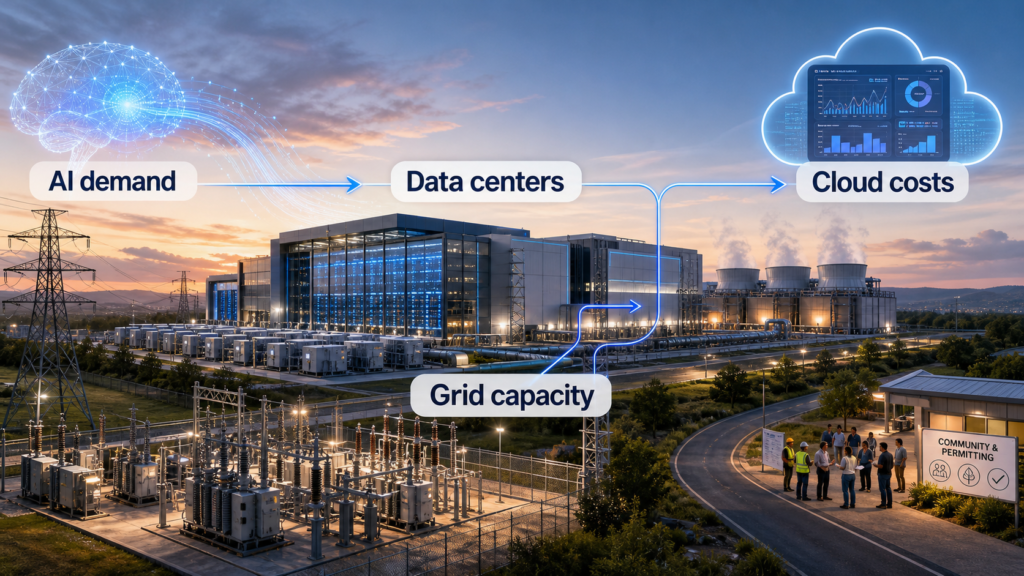
This topic connects several ongoing engineering and policy questions, including grid capacity, data-center cooling, local permitting, and electricity pricing. The central technical point is that AI is no longer only a model race. It is also a power, grid, cooling, land, and reliability race. Readers who use AI tools do not need to become utility engineers, but they should understand why the cloud is starting to look less infinite.
The practical takeaway is simple. AI services are still useful, but the real cost of AI is not only the subscription price on a checkout page. It includes electricity supply, grid interconnection, cooling, backup generation, site approval, chip availability, and whether the workload actually needs a large cloud model. That is why a good AI plan now connects cloud AI with local AI vs cloud AI decisions, budget controls, and realistic expectations.
Why AI suddenly became a power-grid story
For years, cloud computing trained users to think of compute as something elastic: open an account, choose a region, scale up, scale down, and pay the bill. AI changed the size and shape of that demand. Large model training uses dense clusters of accelerators. Inference at scale means millions of users sending prompts, images, code, documents, voice, search tasks, and agent actions through data centers every day. Even when the model output looks small, the system behind it can be power-intensive.
The U.S. Energy Information Administration has tracked data center server energy use across commercial buildings, and its Short-Term Energy Outlook has been watching rising electricity demand. NERC’s reliability assessments frame the grid side: planners care about peak demand, reserve margins, transmission, generation availability, and large load growth. Brookings has been warning that moratoriums alone do not solve the oversight problem and that ratepayer protection needs enforcement when data centers drive infrastructure costs.
AI demand
More people use AI for search, coding, writing, design, customer support, image generation, and agent workflows.
Compute density
AI workloads concentrate high-power chips into dense server rooms that need stable electricity and cooling.
Grid interconnection
New sites may need substations, transmission upgrades, generation contracts, and long approval timelines.
Cooling load
Servers turn electricity into heat. Cooling, water, chillers, airflow, and thermal design become part of the AI cost chain.
Reliability planning
Utilities and grid operators must plan for peak demand, outages, backup power, and load flexibility.
Cloud pricing
When power, chips, and facilities get expensive, those costs can move into AI subscriptions and API pricing.
The physical chain behind one AI answer
A normal user sees a prompt box. Behind that prompt is a layered infrastructure chain. The model runs on servers. Servers sit in racks. Racks draw power and produce heat. Cooling systems remove that heat. Power equipment conditions electricity. Substations connect the campus to the grid. Utilities plan for the load. Local governments review land, water, noise, tax, and reliability issues. The user only sees an answer, but the answer depends on every link in that chain.
This is why a single data-center announcement can become a local story and a national infrastructure story at the same time. A company may want fast AI capacity. A utility may need time to connect the load. A community may want jobs and tax revenue but worry about bills, water, noise, emissions, or land use. A cloud customer may only care that the AI service stays fast and affordable.
Chips
GPUs and AI accelerators are the engines of modern AI training and inference. Their availability and power draw shape capacity.
Racks
Dense AI racks can demand more power and cooling than older enterprise server layouts.
Cooling
Air cooling, liquid cooling, chillers, water strategy, and heat rejection all affect site design.
Substations
Large campuses need electrical infrastructure that can safely deliver high loads.
Transmission
A site may be close to land but far from available grid capacity. That delay matters.
Permits
Local approvals, environmental review, utility agreements, and community negotiations can decide whether a project moves.
What changed this week
The current attention spike comes from a dense news cluster around AI data centers, power availability, local pushback, grid planning, and whether large new loads should receive special treatment. Some reports focused on power-line failures and reliability. Others focused on federal land, ratepayer protection, emergency power auctions, co-location with generation, or community resistance. The exact stories will keep changing, but the pattern is clear: AI infrastructure is moving from a tech-industry back office topic into public power planning.
This article uses stable public sources for the long-lived explanation because individual news URLs can be blocked, move behind paywalls, or age quickly. The reader value is the framework: when you see another headline about an AI data center, ask which part of the chain is under pressure.
Power availability
Can the grid serve the load at the time and place the developer wants?
Who pays
Do data-center costs stay with the developer, or do ordinary ratepayers absorb part of the upgrade burden?
Reliability
Can large loads reduce demand, use backup power, or pause during grid emergencies without hurting critical services?
Cooling and water
Does the site design fit local water, heat, climate, and efficiency constraints?
Land and permits
Does the project fit local planning, noise, tax, environmental, and community rules?
Cloud customer impact
Will higher infrastructure costs make AI API, search, coding, and agent tools more expensive?
Why cloud AI costs may not stay flat
AI pricing can look mysterious because the user buys tokens, seats, credits, or a monthly plan. Underneath that price are chips, electricity, cooling, data-center leases, networking, engineering, model development, safety work, support, and margin. If power and facilities become harder to obtain, providers have several choices: raise prices, limit free usage, route smaller tasks to cheaper models, slow rollouts, reserve capacity for enterprise customers, or push users toward local/hybrid workflows.
This is already visible in how many AI products now have tiered plans, context limits, model limits, rate limits, and premium features. It is not only a product strategy. It is also capacity management. The AI coding tools guide and AI search optimization guide both sit downstream of the same infrastructure question: what happens when more workflows expect AI on demand?
Free tiers shrink
Providers may reduce free capacity or reserve stronger models for paid users.
Smaller models expand
Routine tasks may move to smaller or cheaper models to preserve high-end capacity.
Regional rollout varies
AI features may launch first where power, data centers, compliance, and network capacity are easier.
Enterprise gets priority
Large contracts can justify reserved capacity, dedicated infrastructure, and stricter service levels.
Local AI becomes practical
Some private drafts, notes, coding tasks, and document summaries can run locally when quality is enough.
Automation needs budgets
Agents and API workflows should have token, spend, and fallback rules so cloud cost does not surprise users.
The local AI angle: not everything needs the biggest cloud model
The power crunch does not mean everyone should abandon cloud AI. Big cloud models are still better for many tasks: difficult reasoning, multimodal work, coding help, large context, fresh tool integration, and enterprise reliability. But it does mean users should stop sending every tiny job to the largest available model by default.
Local AI can help with private drafts, rough summaries, offline notes, repetitive cleanup, simple classification, and first-pass brainstorming. A hybrid workflow can use local models for low-risk bulk work and cloud models for final reasoning, source synthesis, publishing, or high-stakes decisions. That is the same pattern behind choosing CPU, GPU, and NPU local AI hardware without wasting money.
Use local AI for
Private first drafts, routine summaries, simple extraction, brainstorming, tagging, and low-risk batch cleanup.
Use cloud AI for
High-quality final writing, hard reasoning, current source synthesis, multimodal work, production coding, and sensitive verification.
Avoid local-only pride
A slower local model that produces weak answers can waste more human time than it saves.
Avoid cloud-only habit
Sending every small cleanup task to premium cloud models can waste money and capacity.
Measure the task
Track quality, time saved, privacy sensitivity, cost, and whether the output needs human review.
Build fallback paths
When a cloud model is rate-limited or expensive, route easy work locally and reserve cloud calls for final passes.
What builders and small teams should watch
For developers, creators, and small teams, the power story becomes practical when it touches bills and architecture. If your product depends on AI APIs, your risk is not only model quality. It is also rate limits, regional availability, inference cost, latency, and whether your users expect the expensive model for every action. If you are building agents, connect this with AI agent payment controls: power and compute cost are part of the agent budget.
Token budget
Set per-user, per-task, and per-agent limits. Do not let background agents run without cost ceilings.
Model routing
Use smaller models for easy tasks and stronger models only where they change the result.
Caching
Cache stable summaries, embeddings, and repeated answers when policy and freshness allow it.
Batching
Batch low-priority work instead of creating constant peak demand.
Local fallback
Use a local or cheaper fallback for drafts, classification, and bulk cleanup.
User expectation
Explain when a task uses a premium model, a faster model, or a local/private workflow.
What ordinary AI users should do
Most readers do not need to track every data-center permit. They do need a practical mental model. If an AI feature becomes slower, more expensive, region-limited, or capped, the cause may not be the app alone. It may be the infrastructure chain behind the app.
Pick the right model
Use premium models for difficult work. Use cheaper models for routine drafts and summaries.
Save useful outputs
Do not repeatedly regenerate the same answer when a saved checklist or note would work.
Be careful with agents
Background agents can spend tokens and money while you are not watching.
Watch plan limits
Read fair-use rules, rate limits, model access, file limits, and API pricing before depending on a tool.
Try hybrid work
Use local AI for private rough work and cloud AI for final polish or hard problems.
Value reliability
For business-critical work, choose tools with clear uptime, export, and fallback options.
Community and policy questions are part of the story
AI infrastructure is not just a private technology decision. Data centers can bring jobs, tax revenue, network investment, and local economic activity. They can also raise questions about water, land, noise, backup power, emissions, and who pays for grid upgrades. Brookings’ work on moratoriums and ratepayer protection is useful because it avoids a simplistic yes-or-no frame. The real question is how to approve useful infrastructure with clear rules, transparent costs, and measurable accountability.
That matters for AI users because public trust affects rollout speed. A data center that surprises a town with opaque power demands may face resistance. A project that explains load flexibility, ratepayer protection, water strategy, emergency response, jobs, and tax terms has a better chance of being evaluated on facts.
Good question
Who pays for new substations, transmission, backup systems, and utility upgrades?
Good question
Can the site reduce load during grid emergencies without harming critical services?
Good question
What are the water, cooling, noise, and local land-use impacts?
Good question
Are tax incentives tied to clear jobs, infrastructure, reliability, and community benefits?
Good question
Is the project using clean power claims carefully, with actual matching and timing details?
Good question
How will the public know whether promised protections are enforced?
How to read future AI power headlines
When another AI power headline appears, separate four layers: demand, supply, delivery, and cost. Demand is how much compute AI companies want. Supply is generation, contracts, backup power, and clean-energy claims. Delivery is the grid, substations, interconnection queues, and transmission. Cost is who pays and how quickly the expense flows into cloud products, utility bills, taxes, or local incentives.
Demand headline
Look for model growth, user growth, enterprise AI adoption, and agent workloads.
Supply headline
Look for power purchase agreements, generation projects, backup turbines, and clean-energy matching.
Delivery headline
Look for substations, transmission, interconnection delays, and grid-operator warnings.
Cost headline
Look for ratepayer protection, cloud price changes, tax incentives, and infrastructure financing.
Reliability headline
Look for load flexibility, emergency curtailment, outage planning, and backup power rules.
Local headline
Look for community meetings, water use, noise, land use, jobs, tax revenue, and permit conditions.
Source notes and date checked
Sources were checked on July 30, 2026. This topic changes quickly, so treat market-size estimates and project timelines as dated context rather than permanent facts. This article is practical technology and infrastructure guidance, not utility-rate, legal, tax, environmental, or investment advice.
- EIA: data center server energy use
- EIA Short-Term Energy Outlook
- NERC reliability assessments
- Brookings: data center moratoriums and oversight
- Brookings: protecting ratepayers from AI data center costs
- EPA greenhouse gas equivalencies calculator
- Google data center efficiency
- AWS cloud sustainability
- NVIDIA data center platform
- Goldman Sachs: AI power demand
- Uptime Institute global data center survey
- NIST AI Risk Management Framework
- ASHRAE data center technical resources
FAQ
Does AI really use enough electricity to matter?
At the level of one user prompt, the amount can feel invisible. At the level of millions of users, model training, inference, storage, cooling, networking, and backup systems, the load becomes large enough for utilities, grid operators, and local governments to plan around.
Will AI make my electricity bill go up?
Not automatically from your personal AI use. The ratepayer question is about who pays for grid upgrades, generation contracts, and local infrastructure when large data centers connect to the system. That depends on utility regulation, contracts, location, and policy enforcement.
Does local AI solve the power problem?
Local AI can reduce cloud calls for some tasks, but it still uses electricity and hardware. It is best viewed as a practical routing choice: use local models where privacy, cost, and adequate quality line up; use cloud models where capability matters more.
Should businesses stop using cloud AI?
No. Businesses should use cloud AI deliberately. Match model size to the task, set budgets, monitor usage, cache repeated work, and keep fallback options. The point is not to avoid AI; it is to avoid pretending compute is free and infinite.
Bottom line: AI is software running on real infrastructure
AI data center power is now part of the AI story because the cloud has a physical body. Every AI answer depends on chips, racks, cooling, substations, grid planning, permits, and cost recovery. That does not make AI bad or unusable. It makes AI a normal infrastructure tradeoff: powerful, useful, expensive, and worth managing carefully.
The smartest next step is not panic. It is better routing. Use premium cloud AI where it genuinely changes the result. Use local or smaller models where they are good enough. Watch plan limits and agent budgets. Read data-center headlines through demand, supply, delivery, reliability, and cost. The better readers understand that chain, the better they can choose tools without being surprised by the bill behind the magic.
A megawatt headline needs both utilization and a boundary
As an illustrative calculation, a 10MW IT load running continuously for 24 hours uses 240MWh at the IT equipment boundary. At an assumed PUE of 1.2, the corresponding facility energy is 288MWh.
| Situation | Next check | Why it changes the decision |
|---|---|---|
| Headline quotes capacity | Ask whether it means IT load or facility load. | Applying PUE twice would overcount. |
| Load varies through the day | Use measured energy or a stated utilization assumption. | Nameplate capacity is not actual consumption. |
| Article compares local and cloud AI | Define the same useful workload and energy boundary. | A desktop wattage and a data-center capacity are not directly comparable. |
The values are assumptions, not measurements of an actual facility. This calculation explains scale; it cannot determine energy per query, grid emissions, water use, or your provider's price.