
Quick answer: for a startup finance-platform shortlist in 2026, begin with Mercury for VC-backed startups, Brex for corporate cards and spend management, Ramp for expense automation, Rho for an all-in-one finance platform, and Bluevine for high-yield checking. Those are the roles assigned in a 2026 comparison, not a universal ranking. The useful move is to pick the operating problem you need to solve first, then validate product fit, availability, terms, integrations, eligibility, and risk controls directly with the provider.
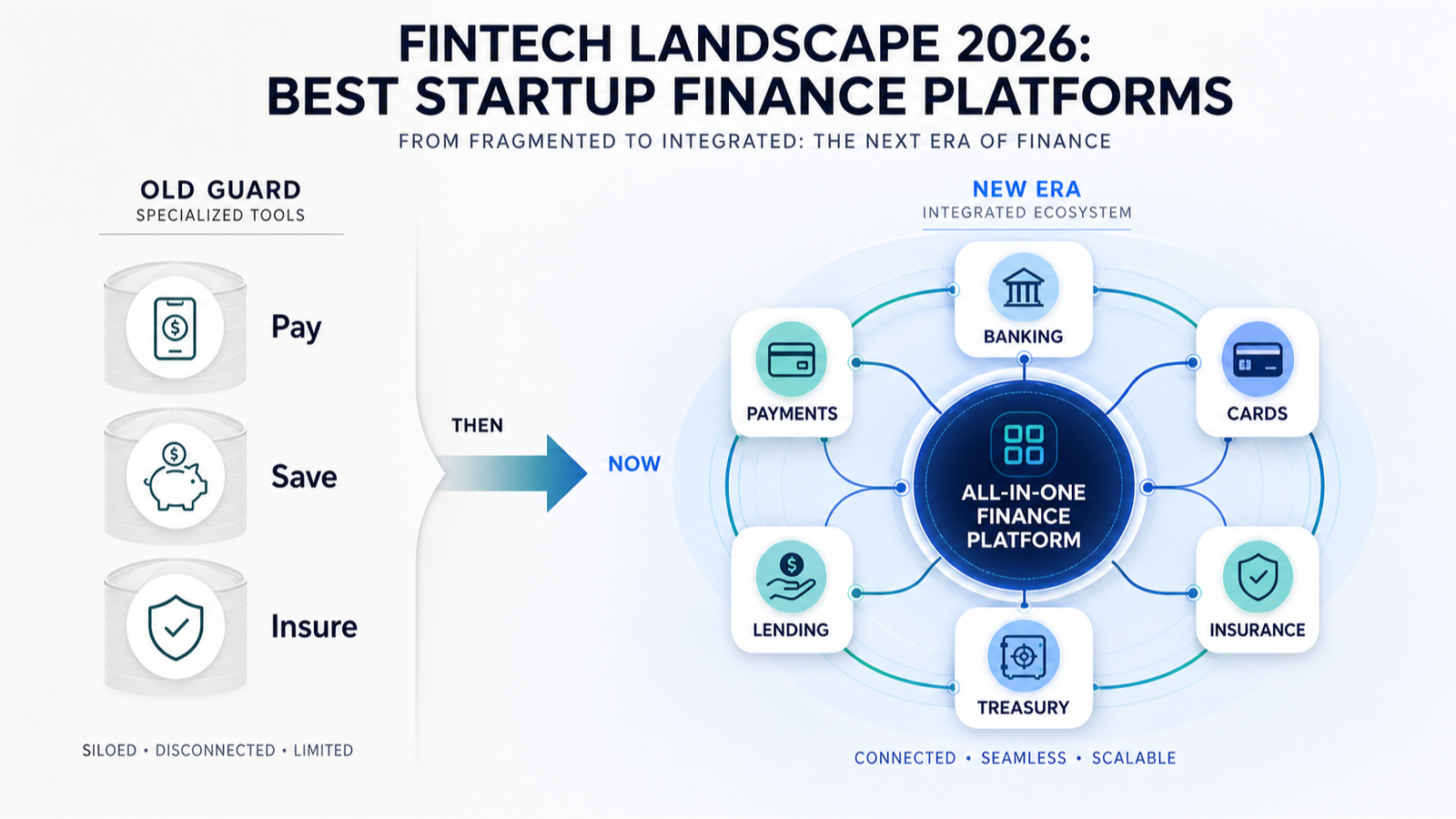
The fintech landscape in 2026 is less about finding a single “best fintech company” than about choosing a platform whose center of gravity matches your business. Banking, cards, expense workflows, payments, lending, insurance, customer conversations, fraud analytics, and AI operations increasingly overlap. That overlap can reduce handoffs, but it can also make an attractive all-in-one promise harder to evaluate. This guide gives you a compact starting shortlist and a decision process for making the next choice more deliberately.
Start with the job, not the brand
A 2026 startup-banking comparison identifies five distinct starting points: Mercury for VC-backed startups; Brex for corporate cards and spend management; Ramp for expense automation; Rho for an all-in-one finance platform; and Bluevine for high-yield checking. The labels matter because they turn a vague search into a real selection question: what financial task is currently creating the most friction for your team?
| Starting option | Best starting use case in the source comparison | Choose it first when your decision is mainly about | What to verify before committing |
|---|---|---|---|
| Mercury | VC-backed startups | Your company fits that operating profile | Eligibility, account terms, supported workflows, and current product availability |
| Brex | Corporate cards and spend management | Card controls and spend-management needs lead the decision | Who needs cards, approval rules, reporting needs, and applicable terms |
| Ramp | Expense automation | Expense work is the clearest operational bottleneck | Which expense steps need automation and how your existing process will connect |
| Rho | All-in-one finance platform | You want to assess a broader finance-platform approach | Which capabilities are genuinely needed now versus merely convenient later |
| Bluevine | High-yield checking | Checking is the priority criterion | Current account conditions, eligibility, and whether checking solves the larger workflow problem |
The table is intentionally a triage tool, not a substitute for diligence. A category label can narrow a shortlist; it cannot tell you whether a specific plan, geography, ownership structure, transaction pattern, compliance obligation, or integration requirement fits your business. Treat the five names as routes into provider-level evaluation rather than as interchangeable badges.
Why the 2026 fintech choice feels different
One industry report describes the traditional vertical categories of fintech as becoming obsolete in 2025 as leading companies expanded horizontally into multi-product “super apps.” It cites payments processors Stripe and Adyen moving into banking and lending, while neobanks such as Revolut expanded into asset management and insurance. The point for a buyer is not that every integrated platform is automatically preferable. It is that product boundaries are less reliable as a shortcut for judging what a platform may try to cover.
That makes scope discipline more valuable. If you are choosing a platform because expenses are painful, a broad ecosystem story should not distract from the operational questions: Which expense handoffs disappear? What remains manual? Who owns approvals? What happens when a workflow needs an exception? And how will your team measure whether the change actually helped?
Likewise, a team choosing for checking should not assume that a wider platform automatically improves the checking decision. Broader capability can be relevant, but it should be evaluated as an additional requirement, not smuggled into the decision simply because the market is converging.
Choose from five practical paths
1. Mercury: begin with the startup profile
Mercury is identified as the default banking choice for VC-backed startups in the cited comparison. Put it first on your list when that description fits your company and your immediate question is which banking option to investigate. The next step is not to infer every feature from the label. Make a short, written list of the banking workflows that matter to your team, then confirm each one in the provider’s current documentation and agreement.
2. Brex: begin with spend management
Brex is identified as best for corporate cards and spend management. Start here when the decision is really about how employees spend, how those purchases are governed, and how finance maintains visibility. Before selecting a platform, map the people and moments that matter: cardholders, approvers, finance reviewers, recurring purchases, exceptions, and month-end follow-up. That map will reveal whether the platform’s spend-management emphasis is aligned with the work you actually need to improve.
3. Ramp: begin with expense automation
Ramp is identified as leading on expense automation. This makes it a natural first comparison point when the cost of your current expense process is time, repeated follow-up, fragmented evidence, or manual reconciliation work. Define the exact workflow you want automated before a demo or trial. “Automate expenses” is too broad to evaluate; “reduce the number of handoffs required to close a routine expense review” is a testable objective.
4. Rho: begin with the all-in-one question
Rho is identified as best for an all-in-one finance platform. Consider that route when fragmentation itself is the problem and you want to assess whether a broader platform can simplify your finance stack. The important test is whether the combined approach improves the few workflows that matter most. A platform should earn its breadth through useful coordination, not through a long feature list.
5. Bluevine: begin with checking
Bluevine is identified as best for high-yield checking. Start here when checking is the decision’s center, rather than an incidental capability bundled with another purchase. Be precise about the outcome you are buying: a checking relationship, a better place for cash operations, or a starting point for a wider finance process. Those are related but different choices, and they deserve different evaluation criteria.
Decision cards for a faster shortlist
If your priority is investor-backed startup banking
Put Mercury on the first-review list. Write down the banking tasks your company must complete, then confirm the relevant current requirements and terms directly with the provider.
If spending control is the immediate pain
Put Brex on the first-review list. Evaluate it through real spend scenarios: a routine purchase, a policy exception, an approver who is unavailable, and a finance review at period close.
If the expense process is consuming attention
Put Ramp on the first-review list. Ask your team which step is most repetitive, which evidence is most often missing, and what a successful automated outcome would look like.
If too many finance tools create handoffs
Put Rho on the first-review list. Separate essential consolidation from aspirational consolidation. A broad platform should solve a documented coordination problem.
If checking is the decisive need
Put Bluevine on the first-review list. Confirm the current checking conditions and decide whether the account is the end goal or only one part of a larger finance redesign.
AI, risk, and compliance belong in the buying brief
Fintech decision-making in 2026 is occurring alongside a move from experimentation to production for selective generative and agentic AI initiatives, according to an industry-leader outlook. Another analysis frames large-scale AI adoption as dependent not only on model capability but on organizational coordination, data foundations, computing costs, and compliance frameworks. For a buyer, that is a useful warning against treating AI as an isolated feature checkbox.
When a vendor presents an AI-enabled workflow, ask what business decision or operational step it affects. Then ask who reviews output, what data enters the workflow, what exception path exists, and what evidence your organization needs to retain. Those questions do not assume a specific product capability. They prevent a procurement process from confusing a compelling demonstration with an operationally ready process.
Risk evaluation deserves similar specificity. Experian’s 2026 fintech material highlights combining traditional credit-risk strategies with first-party fraud analytics to identify hidden risk and improve early-payment-default detection. The broader lesson is straightforward: a finance workflow should not be assessed only for speed or convenience. Decide which risk signals, review controls, and escalation paths are required for the activity you are changing.
How to compare platforms without being dazzled by breadth
Use the same test for every candidate: can you describe the problem, the desired workflow, the required controls, and the success measure in plain language? If not, the comparison is still too vague. The market’s move toward multi-product platforms makes this discipline especially important because a vendor may cover more than one category without being the best fit for your immediate priority.
- Name the decision owner. Finance, operations, founders, security, and procurement may each own a different part of the answer.
- Choose one primary outcome. Examples include evaluating a startup-banking option, improving spend management, reducing expense-process work, considering a unified finance platform, or prioritizing checking.
- List non-negotiable controls. Include only controls that are necessary for your organization’s process and obligations.
- Create two or three real scenarios. A normal transaction, an exception, and a review or reporting moment are usually more revealing than a generic feature tour.
- Verify current facts at the source. Plans, eligibility, availability, fees, product functionality, and contractual conditions can change and should be confirmed directly.
- Define a stop condition. Decide in advance what mismatch would remove a product from consideration.
This process also makes it easier to resist false precision. A comparison article can provide a credible starting role for each product, but it cannot safely answer every company-specific question. Your own operating context supplies the final layer of evidence.
Where customer conversations fit
Not every fintech decision is a banking-platform decision. respond.io describes its product as a customer conversation platform for B2C teams that want to manage chat-based conversations without overcommitting on advanced features; it includes a shared inbox for managing conversations across channels and maintaining visibility into each conversation. That is a different buying category, but it illustrates a wider 2026 pattern: operational platforms are increasingly evaluated by whether they bring fragmented work into a more visible, manageable flow.
If customer conversations sit near payments, onboarding, support, collections, or account operations in your business, keep the boundary clear. A conversation platform should be judged on the customer-workflow problem it is meant to solve, while a banking or finance platform should be judged on the finance-workflow problem it is meant to solve. Integration may matter, but it should not erase the distinction between the jobs.
The 2026 fintech landscape in one page
The market signals in the verified sources point in several directions at once: industry leaders are discussing digital transformation, agentic AI, stablecoins and digital assets, regtech and compliance, digital banking, payments, and AI governance; platforms are expanding across former category lines; and practical risk and operational foundations remain central. That is a lively market, but it is not an instruction to buy every capability from one provider.
A better conclusion is narrower. Choose the platform category that maps to the operational problem you have today. Use Mercury as a starting point for a VC-backed startup-banking evaluation; Brex for corporate cards and spend management; Ramp for expense automation; Rho for a broader all-in-one finance-platform evaluation; and Bluevine for high-yield checking. Then verify the current product facts that matter to your organization before making a commitment.
Evidence limits and final checks
This article uses a limited set of verified 2026 sources. The startup-platform recommendations are grounded in one comparison source’s stated best-use-case labels, while broader market observations come from separate industry sources. The sources do not establish that any option is best for every business, nor do they provide a complete current comparison of fees, eligibility, availability, security controls, integrations, or contractual terms. Confirm those details directly before choosing a provider.