AdSense approval checklist WordPress blog: This AdSense approval checklist for a WordPress blog is built for one practical question: would a real reader and a real reviewer trust this site before ads are added?
Use this checklist with AdSense Approval Checklist, use the next step with WordPress Categories, and keep Search Console for New Bloggers nearby before publishing or monetizing the site.
Where this fits in the abcnote stack
AdSense approval work depends on the same publishing foundation as WordPress categories, Search Console, screenshot quality, and useful AI-assisted writing. Continue with these public abcnote guides: WordPress Categories, Search Console Metrics, AdSense Approval Checklist.
Quick answer
Use this guide to make a cleaner decision, avoid beginner mistakes, and prepare a site that looks useful before monetization.
What You Will Learn
- How to prepare a new WordPress blog before AdSense
- Which pages and navigation signals build trust
- How to avoid thin AI-assisted content
Reference Screenshots
These screenshots were captured from the relevant official sites while preparing this article. They are used as visual references so the guide feels concrete, not generic.
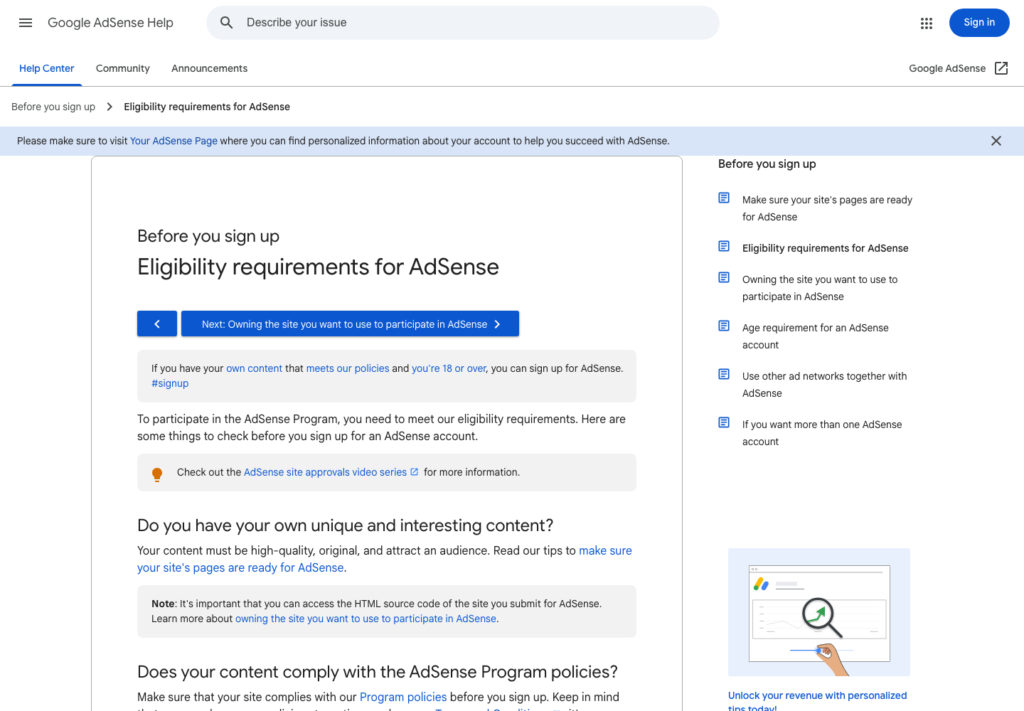
There is no official rule that says a new blog must have exactly 30 posts before applying for AdSense. That number appears often in creator discussions because it is a practical target: enough content to make the site feel real, but not so much that you spend months waiting.
The better question is not "Do I have enough posts?" The better question is "Does this site look useful, original, navigable, and ready for real readers?"
This checklist is built for a new WordPress blog that wants to apply for AdSense without looking thin, unfinished, or risky.
1. The site has a clear topic area
A new site does not need to be narrow forever, but it should not look random during review.
For the approval stage, choose one connected topic area. For example:
- WordPress setup
- beginner blogging
- AdSense preparation
- AI-assisted writing workflows
- SEO and AEO basics
- publishing automation
Those topics naturally connect. A site that jumps from recipes to crypto to celebrity news to hosting reviews looks less trustworthy because the reader cannot tell what the site is about.
2. The posts answer real beginner questions
A post should help someone make a decision, complete a task, avoid a mistake, or understand a concept.
Good approval-stage posts often include:
- step-by-step explanations
- checklists
- decision guides
- definitions for beginners
- common mistakes
- source links
- realistic next steps
Weak posts often repeat obvious statements without helping the reader do anything.
3. The content is original
Original does not mean every idea has never existed before. It means the article is not copied, spun, or stitched together from search results.
A practical way to add originality is to include:
- your decision criteria
- your checklist
- your workflow
- your mistakes to avoid
- your order of operations
- your honest limits
Make the article do more than define the topic. For example, instead of only saying that a site needs useful content, explain how a beginner can review one post: identify the reader’s question, state the answer early, add the steps needed to act on it, and remove sentences that repeat the same point.
Originality can also come from the choices you make clear. A post about categories can explain why a small site should keep only categories it can maintain. A post about Search Console can explain which metrics a beginner should check first and which numbers should not trigger a rushed rewrite. These are useful editorial decisions, not recycled definitions.
Before publishing, ask whether a reader could use the article without opening five other search results. If the answer is no, add the missing decision rule, example, warning, or next step. For AI-assisted writing, this matters even more: AI can help structure a draft, but the final post should contain a clear editorial point of view.
4. The required trust pages exist
Before applying, create the basic pages readers and reviewers expect:
- About
- Contact
- Privacy Policy
- Terms of Use, if appropriate
- Disclaimer, if the site discusses tools, money, or recommendations
- Editorial Policy, especially if AI helps create drafts
These pages should not be empty templates. They can be simple, but they should accurately explain who runs the site, what the site covers, and how readers can contact you.
5. The site is easy to navigate
A reviewer should be able to understand the site quickly.
Check:
- menu links work
- categories are not empty
- homepage shows real content
- posts link to related posts
- there are no broken buttons
- the footer has basic policy links
Do not create 10 categories if only two have posts. A smaller, cleaner site is better than a large site that feels unfinished.
6. Mobile reading is comfortable
Most readers will see the site on a phone. Approval-stage content should be readable on mobile without zooming or fighting the layout.
Check:
- title does not break awkwardly
- paragraphs are short
- font size is readable
- tables do not overflow
- images are not huge
- sticky elements do not cover content
- no empty monetization blocks or empty blocks appear before approval
If the site feels messy on mobile, fix that before applying.
7. The site does not depend on misleading monetization claims
Avoid headlines that promise guaranteed AdSense approval or fast income. These claims are not useful, and they make the site feel like a course funnel.
Better framing:
- "How to prepare"
- "What to check"
- "Mistakes to avoid"
- "A beginner workflow"
- "A practical readiness review"
AdSense is not a guaranteed income button. Treat it as a system that needs useful content, traffic, testing, and time.
8. AI use is controlled
Google’s public guidance focuses on usefulness and value, not whether a human or AI wrote every sentence. But using generative AI to create many low-value pages can create spam-policy risk.
Use AI as a drafting assistant, then give every article a human editorial pass. A useful pass checks whether the opening answers the headline, whether each section adds a distinct point, and whether the advice tells the reader what to do next.
For a safer workflow:
- Use AI for research organization and first drafts.
- Add your own judgment, examples, and order of operations.
- Check factual claims against the source links you plan to publish.
- Remove repeated filler, vague transitions, and claims that the article does not support.
- Compare related posts so they do not answer the same question with slightly different wording.
- Read the finished page on mobile and review every draft before publishing.
A quick test helps: highlight the sentences that tell the reader to decide, check, compare, or act. If very few sentences survive that test, the draft may be explaining a topic without providing enough practical value. Add a checklist, a realistic example, or a clear boundary rather than making the article longer with generic advice.
The goal is not to hide AI use. The goal is to avoid low-value output and publish pages that remain useful after the first read.
9. Search Console is ready
Before applying, connect Google Search Console if possible. It helps you see whether Google can discover and index your pages.
Watch:
- indexed pages
- crawl errors
- top queries
- impressions
- click-through rate
- pages that are not indexed
You do not need huge traffic before applying, but you should know whether the site is technically visible.
Final readiness question
Before applying for AdSense, ask this:
If a real beginner found this site from Google, would they leave with a clearer decision, a useful checklist, or a next action?
If the answer is yes across the site, you are closer to being ready. If the answer is no, write fewer but better posts before applying.
Useful references: Google AdSense eligibility guidance, Google SEO Starter Guide.
Related reading
Before You Publish
- Confirm the title includes the focus keyword naturally.
- Check that the meta description is clear and not too short.
- Add one or two relevant internal links after related posts exist.
- Use only images that you own, created yourself, or have permission to publish.
- Keep the article ad-free until AdSense is approved and connected properly.
The practical goal is not to make the article look optimized only to a plugin. The goal is to make it readable, trustworthy, and useful enough that the optimization score reflects real quality.
Reader readiness checklist
Use this final review before submitting an AdSense application:
- Can a first-time visitor identify the site’s topic from the homepage, menu, and recent posts?
- Does each important post answer a specific question and give the reader a usable next action?
- Do About, Contact, Privacy Policy, and other relevant trust pages accurately describe the site?
- Can a reader reach related guidance through working internal links and clear navigation?
- Does the site remain easy to read on a phone, including images, menus, and tables?
- Have you removed empty ad placements, misleading income claims, and unfinished-looking page elements?
- Were facts, policy references, and platform details checked against the linked official sources?
If one answer is no, fix that issue before applying. The strongest preparation is not a larger pile of posts; it is a site where a visitor can find a useful answer, understand who runs the site, and move to the next relevant page without confusion.
AdSense Approval final checks
AdSense Approval should improve reader trust before it tries to improve rankings. Confirm the official source, keep the user-facing promise narrow, and remove anything that looks like a private planning note instead of public advice.
For current details, review Google AdSense eligibility requirements. Documentation, pricing pages, eligibility language, and product screens can change, so the final draft should match current source pages instead of relying only on old screenshots.
| Check | What to verify | Why it matters |
| Content | Review whether each article gives a useful answer that is not copied or thin. | Approval depends on original value, not article count alone. |
| Trust pages | Check About, Contact, Privacy, and site navigation. | Reviewers need a real site, not a pile of posts. |
| Policy | Remove empty ad boxs and unsupported monetization claims. | Pre-approval pages should stay clean. |