Quick answer: World Cup 2026 is not using one all-purpose AI agent. It is becoming a multi-agent sports technology ecosystem: referee AI prepares evidence, coaching AI helps analysts search match data, connected-ball tracking improves timing, broadcast AI explains decisions visually, operations AI watches stadium risks, and fan assistants answer practical questions. The important safeguard is still the same: AI supports decisions, but human officials, coaches, and organizers remain accountable.
Before publishing, connect this draft to Korea eSIM or Pocket Wi-Fi Guide, AI Browser Agent Safety, and Cloud AI Privacy Checklist so readers have a real next step instead of a dead end.
AI World Cup decision check
AI World Cup is the practical lens for this comparison. Keep the named options visible in the tables and examples, then use this short checklist to decide by privacy, cost, setup difficulty, performance, and recovery risk.
For a stronger setup path, pair this guide with AI Automation Workflows, then compare Browser Automation, and finish by reviewing Webhooks Explained.
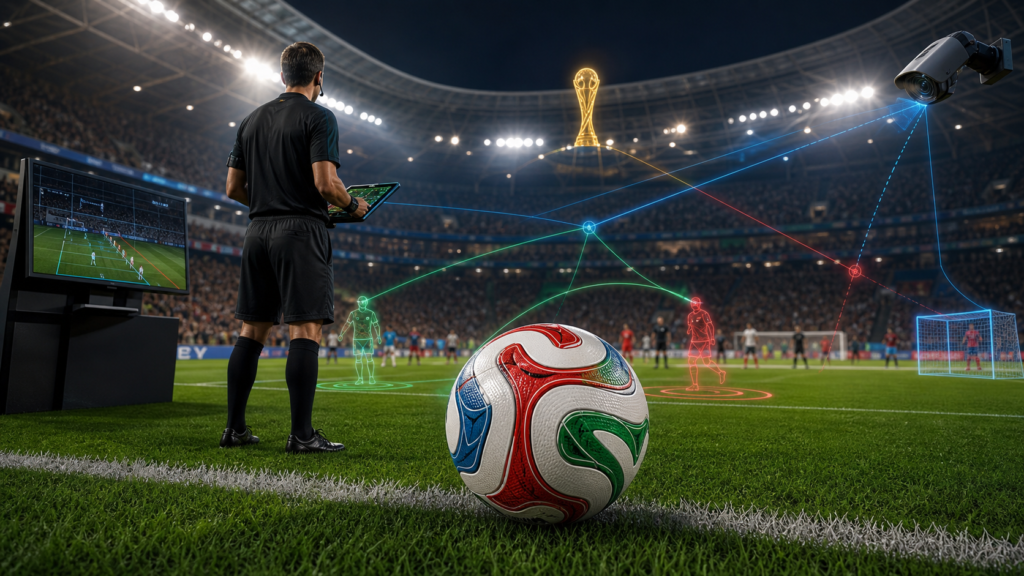
The topic matters because fans search World Cup matches for emotion, controversy, star players, and explanations. A match such as England vs Argentina on July 15 gives the article a natural hook: a possible offside call, Messi receiving between the lines, England’s defensive shape, and the question of whether AI can make football feel fairer or more mechanical. Kylian Mbappe belongs to the France storyline, so he fits better as a separate superstar-analysis case, not inside the England-Argentina matchup.
AI referee may cancel an England goal for offside
The strongest real-world AI-agent case is the referee system. It works in a high-pressure environment where one close decision can change a semifinal. Semi-automated offside technology combines stadium cameras, player tracking, body-pose estimation, connected-ball timing, and 3D replay generation. The system can prepare offside evidence quickly, but the final decision still goes through VAR and the on-field referee.
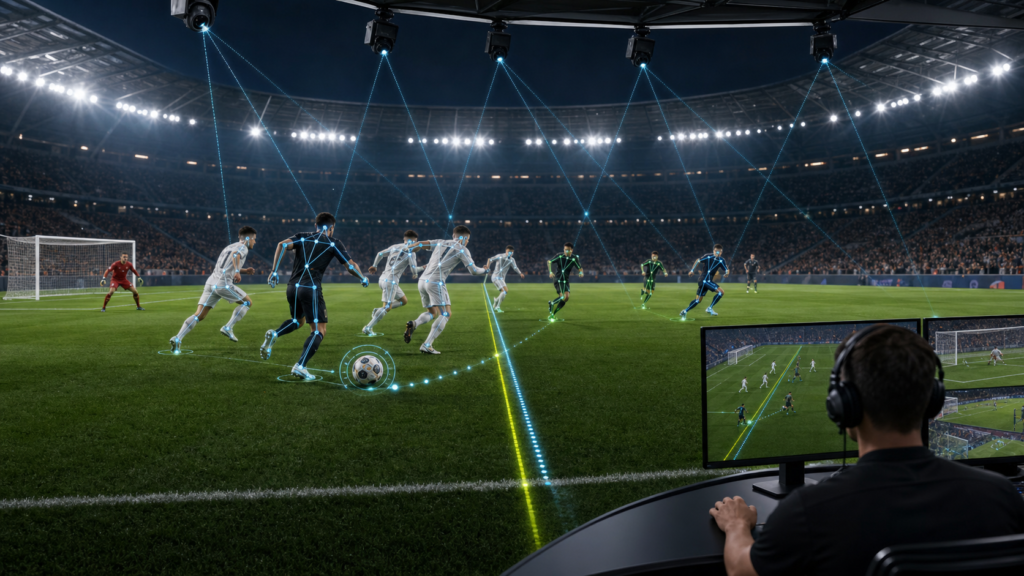
Think about a late England attack against Argentina. The ball is played forward, an attacker moves behind the defensive line, and the crowd celebrates. The referee AI system does not care about the noise, the rivalry, or the player name. It checks the kick moment, the attacker’s legal scoring body parts, the second-last defender, and whether the player gained an offside advantage. That narrow job is what makes it an agent: it senses the match, calculates evidence, estimates confidence, and sends an actionable package to humans.
The offside chain: cameras, ball sensor, body pose, VAR
The architecture is closer to several cooperating agents than one model. A camera-tracking layer identifies player positions. A ball layer helps identify the exact kick moment. A pose-estimation layer separates legal body parts such as head, shoulder, knee, and foot from hands and arms. A geometry layer compares those positions with the defensive line. A replay layer turns the result into a 3D explanation that officials and viewers can understand.
| Layer | What it contributes | Human safeguard |
|---|---|---|
| Stadium cameras | Player location and movement | VAR checks the selected frame and context |
| Connected ball | More precise touch timing | Officials confirm the relevant play phase |
| Pose estimation | Legal scoring body-part position | Officials judge interference and advantage |
| 3D replay | Clear visual explanation | Referee makes the final call |
Messi receives between the lines; AI finds the pattern
The coaching side is different from refereeing. FIFA AI Pro is designed for coaches and analysts who need to search official match data, event data, tracking data, video, and tactical views. Instead of watching hours of clips manually, an analyst can ask targeted questions about build-up play, pressing failures, overloads, transitions, or a star player’s receiving zones.
In an England-Argentina match, a coach might ask for every sequence where Messi received behind England’s midfield line, every time England’s left side was overloaded before a cross, or every possession where Argentina escaped pressure through the center. The value is not prediction. The value is fast retrieval, context, and repeatable tactical evidence.
Mbappe belongs in the France speed-data story
Mbappe is a useful search-interest name for this topic because AI systems can analyze sprint timing, defensive matchups, pressing triggers, transition runs, and fatigue signals around elite forwards. But he should not be placed into an England vs Argentina scenario. A cleaner article structure treats Messi as part of Argentina’s semifinal storyline and Mbappe as a France/superstar-performance storyline.
| Search interest | AI-agent angle |
|---|---|
| Messi vs England | Receiving zones, passing lanes, defensive line, offside checks |
| Mbappe and France | Sprint timing, transition threat, marking distance, fatigue signals |
| Referee AI controversy | Evidence package, confidence, VAR review, human final call |
AI coaching tools turn match data into clips
FIFA and Lenovo describe FIFA AI Pro as a football-specific assistant using official match data and a Football Language Model. For teams, the practical promise is speed. Analysts can move from a question to clips, charts, average positions, passing networks, and 3D views faster than a fully manual workflow.
This matters for smaller federations as much as famous teams. World Cup 2026 has 48 teams, and not every staff has the same analyst depth. A shared analysis tool can make sophisticated video and tracking work more available, while still leaving tactical judgment to coaches.
Broadcast AI makes tight calls easier to trust
Fans do not only want the decision. They want to understand it. Broadcast AI can stabilize Referee View footage, generate 3D avatar replays, and turn complex tracking data into a visual story. That is especially important when a goal is ruled out, a defender steps up at the perfect moment, or a star player is judged offside by a shoulder or knee.
Operations AI watches the tournament outside the pitch
The 2026 tournament spans 48 teams, 104 matches, and 16 host cities. That scale creates an operations problem: ticketing, crowd flow, venue systems, transportation, security signals, weather risk, media operations, and communication. Lenovo describes an Intelligent Command Center that helps organizers see operational patterns and risks earlier.
For fans, the visible result may be simpler: better gate guidance, parking answers, transit updates, schedule help, and faster recovery when systems fail. Behind the scenes, cybersecurity and abuse-detection systems may also monitor suspicious activity, harmful messages, and account threats around players and tournament systems.
What this teaches AI-agent builders
The best lesson from World Cup 2026 is scope. A referee agent should not write scouting reports. A coaching agent should not decide offside. A broadcast agent should not manage crowd transport. Each agent needs reliable input data, a narrow job, a clear output, and a human accountable for the final action.
Businesses can learn from that design. Start with one useful agent that sees trusted data, performs one valuable task, explains its result, and hands the output to the right person. The World Cup works as an AI-agent case study because it shows coordination without pretending that one system should do everything.
FAQ
Is World Cup 2026 run by one AI agent?
No. It is better understood as a multi-agent ecosystem. Referee support, coaching analysis, broadcast replay, operations monitoring, cybersecurity, and fan help use different systems and different safeguards.
Does referee AI make the final call?
No. The AI system prepares evidence and recommendations. Human VAR officials and the on-field referee remain responsible for the decision.
Sources checked
- FIFA: Lenovo World Cup 2026 technology, avatars, and FIFA AI Pro
- Lenovo StoryHub: technology transforming FIFA World Cup 2026
- FIFA: offside decisions, referee body cams, and Football AI Pro
- FIFA media release: Football AI Pro and AI-powered innovations
- FIFA: connected ball technology
- FIFA: Trionda official match ball
- Adidas: Trionda official match ball
- Sky Sports: England vs Argentina semifinal schedule
Last checked: July 13, 2026.
AI Agents at World Cup 2026 checks before publishing
AI Agents at World Cup 2026 decisions should stay practical: confirm the official documentation, choose the safer default, and test the workflow before depending on it for real files, accounts, or production tasks. This section tightens the article around current source checks and the key decision readers need to make.
Before publishing, recheck FIFA technology information for current details. Pricing, platform support, model behavior, and security controls can change, so the article should keep the source date visible when those details affect the recommendation.
| Decision point | Best action | Risk avoided |
| Refereeing | Treat automated calls as decision support with review. | Overstating what sports AI can decide alone. |
| Teams | Separate coaching insight from player privacy limits. | Turning analysis into surveillance. |
| Fans | Use AI for routing, safety, and media only with clear controls. | Automated operations without accountability. |
AI World Cup signals to verify before the tournament
AI World Cup coverage should separate confirmed tournament technology from vendor hype. Referee support, ball sensors, broadcast graphics, crowd operations, translation tools, and security workflows can all involve AI, but each claim needs a source and a human-review note. A travel reader may care more about connectivity and apps, so connect this guide with Korea eSIM or Pocket Wi-Fi Guide. A workflow reader may care more about agent safety, so compare the same control idea with AI Browser Agent Safety and Cloud AI Privacy Checklist.
| Signal | Best evidence | Reader takeaway |
| Referee/offside tools | FIFA, IFAB, match technology, or official tournament communications | AI supports decisions; it does not remove human accountability. |
| Fan operations | Venue, transport, ticketing, or official app updates | The practical question is speed, reliability, privacy, and fallback options. |
| Media and coaching tools | Team, league, broadcaster, or vendor documentation | Treat demonstrations as examples until live-tournament use is confirmed. |
For source refresh, start with FIFA football technology and keep dates visible when the article mentions tools that may change before 2026.