
Tech Trends 2026 is most useful when treated as an operating question, not a prediction list: can your organization connect AI work to a business metric, redesign the process around it, and keep learning faster than the technology changes? Deloitte’s report describes an environment in which AI startups have scaled from US$1 million to US$30 million in revenue five times faster than SaaS companies did, while AI knowledge has moved from a years-long half-life to one measured in months. For enterprise leaders, the immediate reward is a sharper way to sort AI activity: distinguish experiments that merely demonstrate capability from work that can improve a real business process at a reasonable cost.
The report’s broader message is not that every company should race to deploy every new model or agent. It is that the old rhythm of studying a technology, approving it, and then gradually incorporating it is under pressure. One CIO quoted in Deloitte’s analysis said that the time required to study a new technology now exceeds that technology’s relevance window. That is a useful warning against slow, detached planning—but it is equally a warning against unmanaged deployment. The practical response is to make learning, measurement, process ownership, and operating-model decisions part of the same program.
This article explains what the 2026 enterprise AI discussion signals, where leaders should focus first, and how to use a short decision framework before calling an initiative “scaled.”
Quick answer: scale a process, not a demo
The central shift is from asking what AI can do to asking how AI can rebuild a business process at a reasonable cost. That framing, echoed in reporting on Deloitte’s Tech Trends 2026, moves the discussion away from novelty and toward implementation. A useful enterprise AI initiative therefore needs more than a promising output. It needs a defined business result, a process that can be changed, accountable owners, and a way to judge whether the new method is better than the current one.
In practice, leaders can use four questions to triage work:
| Decision question | What a credible answer looks like | What to do if the answer is weak |
|---|---|---|
| What business metric is the work meant to affect? | A named metric that the team can observe and revisit. | Do not label the effort a scale program yet; clarify the business outcome first. |
| What process will change? | A specific workflow, decision point, or multi-step task—not a general ambition to “use AI.” | Map the current work and identify the actual handoffs, decisions, and owners. |
| What operating-model change is required? | A clear view of how people, AI systems, and management responsibilities will work together. | Keep the initiative limited until the required roles and controls are explicit. |
| How quickly can the team learn? | A repeatable review cycle that connects results to the business metric. | Reduce scope and create a tighter measurement-and-review loop. |
This is not a technical architecture checklist. It is an executive decision tool. It helps prevent a familiar failure mode: treating a demonstration of model capability as evidence that an organization has changed the way work gets done.
Why the timing feels different
Deloitte’s 2026 analysis makes the pace of change unusually explicit. It says AI startups have reached the US$1 million-to-US$30 million revenue path five times faster than SaaS companies did, and it characterizes AI knowledge as having a half-life of months rather than years. A separate summary of the report likewise describes a sharply compressed AI innovation cycle. These are signals about the environment, not guarantees that every technology decision must be rushed.
The management implication is straightforward: annual planning alone is unlikely to be enough for work that depends on rapidly changing AI capabilities. The answer is not to abandon planning. It is to divide planning into two layers. The first is durable: business priorities, process accountability, acceptable risk, and the metrics that matter. The second is revisable: which tools, models, and implementation approaches are being tested now.
That distinction matters because technology can change without changing the underlying business problem. If a team knows the metric it is trying to improve and the process it owns, it can reassess its technical approach without starting from zero. If it has only a fashionable tool in mind, every technology shift can turn into a new strategy meeting.
From “what can AI do?” to “what work should change?”
Reporting on Deloitte’s Tech Trends 2026 says enterprise customers are increasingly asking how to adopt AI systematically and how to rebuild processes at a reasonable cost, rather than simply asking what AI can do. That is the right distinction for trend research because it changes the unit of analysis. The unit is not the model, the chatbot, or the pilot. It is the business process.
A process lens forces several productive conversations. Where does work begin? Which decisions are repeated? Which information must be interpreted? Where do exceptions go? Which person remains accountable when a system produces a recommendation or completes a step? Those questions are more useful than generic declarations of “AI readiness” because they connect capability to daily operations.
It also makes cost part of the core design. “Reasonable cost” is not merely a procurement concern. It is a test of whether the redesigned process is worth maintaining. A project can produce an impressive output and still be a weak operating choice if its ongoing coordination, supervision, or change burden overwhelms the business benefit. Linking AI strategy to business metrics, as the enterprise-implementation discussion recommends, gives leaders a way to make that trade-off visible.
The operating model is the real scaling test
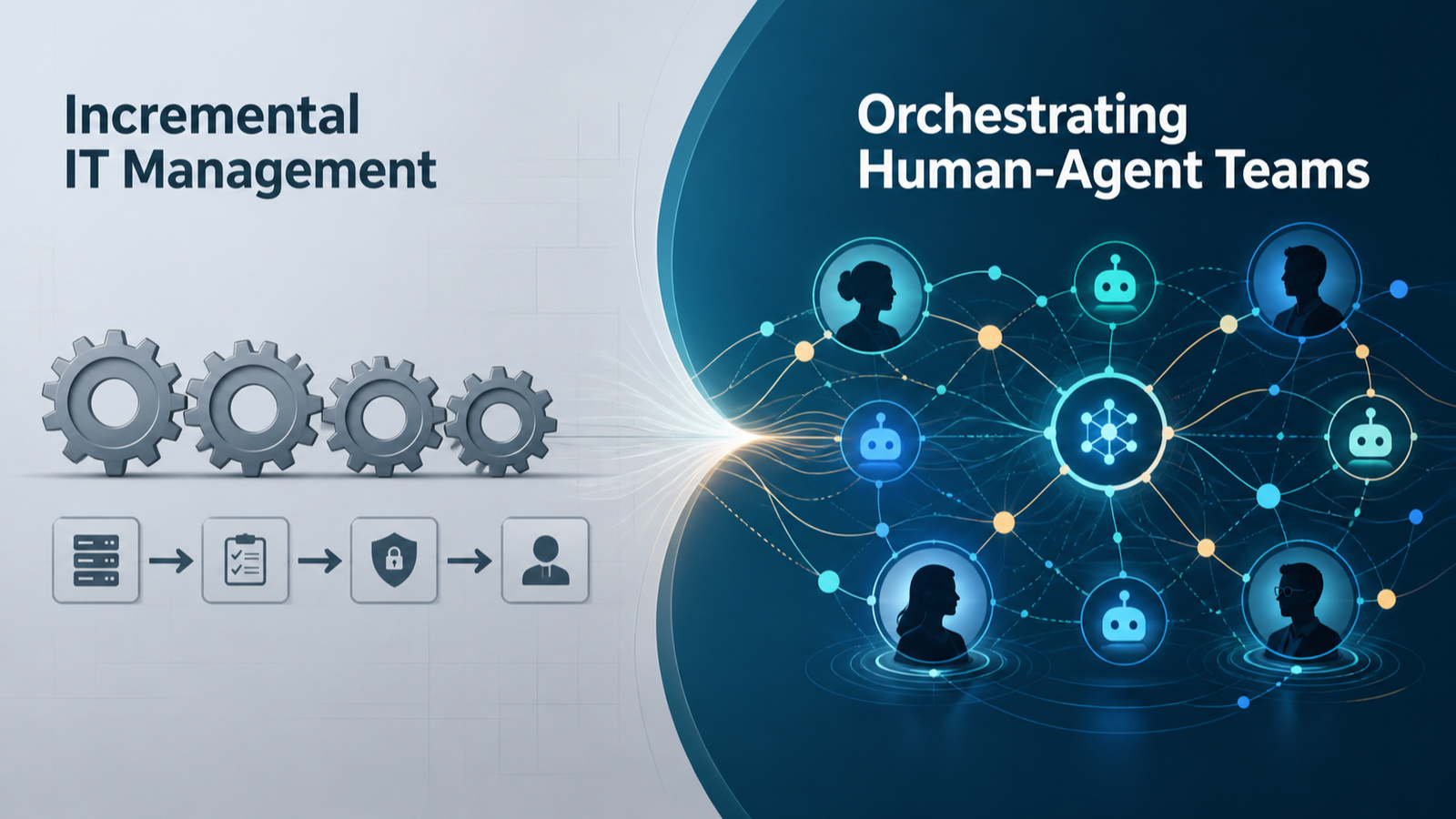
The clearest operational claim in Deloitte’s analysis is that only 1% of surveyed IT leaders reported that no major operating-model changes were underway. The report describes leaders moving from incremental IT management toward orchestrating human-agent teams, with CIOs acting as AI evangelists. Whether an organization is early or advanced, that finding is more useful as a prompt than as a maturity scorecard: what major change is already underway in your own operating model?
“Orchestrating” should not be read as a slogan. It means the organization must decide how human judgment and system activity fit together. In a traditional incremental model, a technology team may introduce a tool while the basic work structure stays largely intact. In a human-agent model, the structure itself can change: tasks may be divided differently, reviews may happen at different points, and responsibility may need to be clarified across people and systems.
That does not eliminate human accountability. It makes accountability more important, because a multi-step system can alter the speed and shape of work. The organization needs named owners for the process, the business metric, the review of outcomes, and the decision to expand or stop the effort. Without those owners, “autonomy” can become a vague label for work that nobody is actually managing.
What to look for in an AI-scale program
A scale program should be recognizable before it is large. The most credible initiatives have a narrow first boundary, a measurable business purpose, and an explicit path from learning to a decision. They do not need to claim that every part of the organization will transform at once. In fact, a smaller, well-owned process can be more informative than a broad program that cannot explain what improved.
1. A business metric comes before tool selection
The enterprise implementation guidance around Tech Trends 2026 explicitly says AI strategy must be linked to business metrics. This is the first filter because it prevents a tool from becoming the strategy. The metric need not be exotic. Its value is that it gives the team a shared way to assess results and decide whether to continue, adjust, or stop.
Be precise about the relationship, though. A metric is not a promise that AI caused every change in it. It is a decision anchor. It keeps the project attached to the business result it was intended to influence and makes later discussions less dependent on enthusiasm or anecdote.
2. The process must be specific enough to redesign
“Improve productivity with AI” is too broad to operate. A usable statement identifies the actual work, the point at which a decision or action occurs, and the people who own the outcome. The goal is not documentation for its own sake. It is to see where the workflow can change and where it should not.
This is especially important when the work includes multiple steps. The more steps a system can complete or influence, the more important it becomes to understand the sequence of work and the points at which people must make decisions. The value of a process map is that it reveals those boundaries before the organization expands the initiative.
3. Learning must happen at the speed of relevance
If the technology’s relevance window can be shorter than the time required to study it, a program needs a faster way to learn. That does not mean eliminating review. It means designing review around a defined question: did this changed process move the chosen business metric in a way that justifies the next step?
Short review loops are valuable because they create a record of decisions. Teams can compare what they expected, what happened, and what must change. That discipline is more durable than attachment to a particular implementation, especially in a field where the underlying technology is moving quickly.
A practical 30-minute leadership review
When an AI initiative reaches a steering group, use the meeting to decide one thing: is this a contained learning effort, a process redesign effort, or an initiative ready to expand? The three categories are intentionally different.
- Contained learning effort: the team is testing a capability, but the business metric or process change is not yet clear.
- Process redesign effort: the team has identified a business metric and a specific workflow, and it is working through the operating-model implications.
- Ready to expand: the team can explain what changed in the process, how it is measured, who owns it, and what it has learned.
Use the following checklist to keep the discussion from becoming a generic technology update:
- State the business metric in one sentence.
- Name the process or multi-step task that will change.
- Describe the new division of work between people and AI systems.
- Identify the process owner and the person accountable for reviewing results.
- State the next decision date and the evidence needed for that decision.
- Say what would cause the team to narrow, pause, or stop the work.
A team that cannot answer these questions may still have a useful experiment. It simply should not be described as enterprise scale. That distinction protects both the experiment and the organization: the first can continue learning, while the second avoids making commitments it cannot yet support.
Agents deserve a more concrete discussion
One summary of Deloitte Tech Trends 2026 identifies AI agents—systems that can autonomously make decisions and complete multi-step tasks—as a transformative but still under-realized enterprise technology trend. That phrasing is worth holding onto. “Transformative” points to the potential significance of systems that can work across steps; “under-realized” cautions against assuming that potential has already become routine enterprise value.
For leaders, the useful question is not whether agents are important in the abstract. It is where a multi-step task has enough structure, ownership, and measurable value to justify redesigning the work around human-agent collaboration. The answer will vary by organization because the relevant process, metric, and operating model vary.
Start with a bounded use case. Make the sequence of tasks visible. Decide where people review, intervene, or take responsibility. Then examine the outcome through the business metric. This approach respects the trend without turning it into a mandate to deploy agents everywhere.
The CIO role is becoming more connective
Deloitte’s report characterizes CIOs as AI evangelists while leaders shift from incremental IT management to human-agent orchestration. The useful reading is not that the CIO alone owns AI. It is that the role must connect technology choices to operating-model changes and business outcomes.
That connective work is demanding because it sits between groups that often use different language. Business leaders may want measurable results. Technical teams may focus on implementation choices. Risk and operations teams may focus on control, continuity, and accountability. A strong enterprise AI program gives those groups a common object to discuss: a defined process, a business metric, a known owner, and a next decision.
This also explains why the trend is not simply about IT modernization. The report’s operating-model signal suggests that the work extends into how organizations coordinate people, decisions, and systems. The technology may enable the change, but management design determines whether the change becomes repeatable.
Common mistakes when interpreting the trend
The first mistake is confusing speed with a requirement to deploy broadly. The evidence describes compressed cycles and faster AI-company growth; it does not establish that every enterprise should make every decision faster. A better response is to shorten the learning loop around clearly defined work.
The second is treating a business metric as a ceremonial KPI. If a metric does not influence whether an initiative changes course, it is not doing the work of a decision anchor. The point is to connect the AI strategy to a business result, then use that connection when making expansion decisions.
The third is assuming that a pilot naturally becomes a scaled operating capability. A pilot can demonstrate that a system produces useful outputs. Scaling requires a different proof: that the process, ownership, measurement, and operating model can support the new way of working.
The fourth is speaking about human-agent teams without defining the human side. The concept becomes practical only when leaders can explain who makes which decisions, how results are reviewed, and who remains accountable for the business outcome.
Evidence limits worth keeping in view
This trend analysis is grounded in Deloitte’s Tech Trends 2026 materials and secondary reporting that interprets them. Some claims describe the report’s findings or the views of sources discussing it; they should not be mistaken for universal forecasts. The sources support a strong conclusion about the direction of enterprise AI conversation—toward systematic adoption, process redesign, business metrics, and operating-model change—but they do not provide a universal implementation blueprint or a guaranteed return for any individual organization.
That limitation is useful. It keeps the article’s practical advice where it belongs: as a decision framework for evaluating enterprise AI work, not as a substitute for the organization’s own process knowledge, measurement, and accountability.
What to do next
If you are responsible for an enterprise AI agenda, choose one live initiative and run the four-question triage table at the top of this article. Do not begin by asking whether the organization is “ready for AI.” Ask whether this particular effort has a business metric, a specific process, an operating-model design, and a learning loop fast enough to remain useful.
That is the practical value of Tech Trends 2026. Its signal is not merely that AI is advancing quickly. It is that enterprise advantage is increasingly tied to the ability to turn that pace into disciplined process change. Organizations that make that connection can evaluate AI initiatives more clearly; organizations that do not may keep accumulating demonstrations without changing the work that matters.
For a complementary way to separate durable signals from short-lived excitement, see Google Trends Checklist for Better Tech Topics. When communicating a process redesign or technology decision visually, Tech Blog Screenshots: How to Use Images Readers Trust offers useful presentation guidance.
Sources
- Deloitte, Tech Trends 2026
- AI Industry Review, Deloitte releases “2026 Technology Trends” report
- Libertify, Deloitte Tech Trends 2026: AI Scaling & Enterprise Guide
- Libertify, Deloitte Tech Trends 2026: AI Goes Physical and the Agentic Reality Check
- DICI Leadership Institute, AI Innovation Half-Life Shrinks to Months