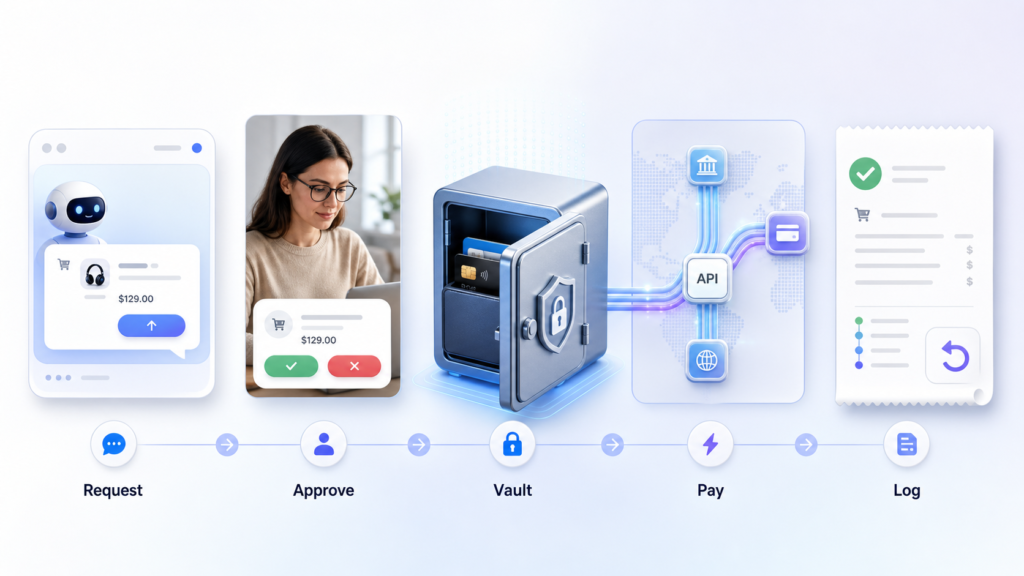
Quick answer: AI agent payments are moving from idea to real product design, but the safe version is not an agent with unlimited access to your credit card or crypto wallet. The safer pattern is a narrow payment workflow: the agent asks, a human or policy approves, a vault releases only the needed credential or token, the payment rail handles the transaction, and the system saves a receipt, audit log, and rollback path.
This is a hot topic because AI agents are starting to act inside shopping, business procurement, software subscriptions, travel booking, support workflows, and machine-to-machine web services. Visa has announced Intelligent Commerce work for AI-enabled buying. The x402 protocol conversation is pushing a different angle: internet-native payments where software can request and settle small payments through an API-style flow. Stablecoin infrastructure providers are also trying to make programmable money easier to use. Those developments are interesting, but ordinary readers should not treat them as an invitation to hand agents a wallet.
The useful question is control. If an AI shopping assistant can compare products, read policies, or draft an order, the risk is manageable. If the same assistant can spend money, subscribe, transfer funds, update billing profiles, or approve renewals, the workflow needs stronger boundaries. The AI shopping-agent security guide explains buyer-side risks. This guide focuses on the money layer: wallets, card vaults, stablecoins, payment APIs, approval gates, spend limits, receipts, and audit trails.
What AI agent payments really mean
An AI agent payment is not one single technology. It can mean a card-on-file workflow where an agent prepares a checkout, a business card product with policy controls, a payment API that lets software request settlement, a stablecoin payment, a wallet with delegated spending rules, or a procurement system where the agent creates a purchase request for human approval. The common thread is that software is doing more of the payment preparation and sometimes more of the payment execution.
That distinction matters. Research, draft invoices, small budgets, and main-account access are different risk levels. Good design separates the agent’s reasoning from the authority to spend.
Research only
The agent compares products, prices, policies, and vendors. It cannot check out or reveal payment credentials.
Draft checkout
The agent fills a cart or prepares an invoice, but a human confirms merchant, amount, shipping, tax, and terms.
Policy-limited spend
The agent can pay only approved merchants, categories, amounts, and time windows.
Wallet or API flow
The agent requests a payment token, stablecoin transfer, or API settlement under a narrow rule set.
Business procurement
The agent creates a purchase request that moves through existing approval, accounting, and receipt systems.
High-risk payment
Transfers, subscriptions, cross-border payments, crypto movement, and irreversible actions need explicit approval.
Why this is getting attention now
Search interest around agentic commerce is rising because AI agents, payment networks, protocol builders, stablecoin infrastructure, browser workflows, and business procurement automation are all moving at once.
The trend is real, but it is still early. Visa’s public Intelligent Commerce announcement is about enabling AI-powered buying experiences with controls. x402 is a protocol idea for payments over HTTP-style flows. Coinbase’s x402 documentation frames it as a way for APIs and websites to require payment. Circle’s USDC documentation explains one stablecoin rail that developers may encounter. The W3C and MDN Payment Request API materials show that browser payment flows have long tried to standardize how sites request payment details from users. The new twist is that agents may sit between the user and the payment step.
Payment networks
Card networks want agent buying to fit familiar merchant, risk, dispute, tokenization, and approval models.
Protocol builders
x402-style ideas aim to let services request payment as part of a web/API interaction.
Stablecoin rails
USDC and similar rails are being discussed because they can be programmable, fast, and API-friendly.
Browser agents
Agents that can navigate websites create pressure to define who approves checkout and subscription actions.
Business automation
Companies want agents to handle repetitive purchases without losing spend control, accounting, or auditability.
Security teams
The money layer forces teams to treat agents as identities with permissions, logs, and rollback plans.
A safe AI payment flow in five steps
A good payment flow should feel boring. The agent should not improvise with money. It should operate inside a predictable chain that humans and systems can inspect. The simplest version has five steps: request, approve, vault, pay, log.
1. Request
The agent states what it wants to buy, from whom, for how much, under which account, and why the purchase fits the task.
2. Approve
A human or pre-set policy approves the exact merchant, amount, category, currency, timing, and subscription status.
3. Vault
The agent never sees raw card numbers, seed phrases, private keys, recovery codes, or broad credentials. A vault releases only a scoped token or approved payment method.
4. Pay
The transaction uses a payment rail, card token, payment API, invoice system, or wallet rule that matches the approved scope.
5. Log
The system stores request, approval, merchant, amount, receipt, tool call, policy result, and rollback or dispute path.
This is where the API keys and app passwords guide becomes relevant. A payment credential is not just another string. If the agent can see it, copy it, print it into logs, or send it to a tool, the credential can escape the workflow. Use tokenization, vaults, temporary credentials, masked logs, and revocation.
Cards, stablecoins, and payment APIs compared
The next few years will probably use several payment models at once. Cards remain familiar to merchants and consumers. Stablecoins are attractive for programmable settlement and cross-border software payments, but they add custody, compliance, and irreversibility questions. Payment APIs and browser standards can make the request flow easier to automate, but they still need user consent and security controls.
Card rails
Best for familiar checkout, business cards, chargebacks, receipts, merchant categories, and existing accounting. The agent should use tokenized or virtual-card access, not a raw card number.
Wallet rules
Useful when the user wants spending limits, merchant allow lists, subscription controls, or one-time approvals. The hard part is making delegation clear and reversible.
Stablecoins
Useful for programmable, internet-native, or cross-border payments. They require extra caution because transactions may be hard to reverse and can drift into investment misunderstanding.
Payment APIs
Useful for machine-to-machine services, usage-based APIs, and automated billing. The agent should request payment; policy should decide whether the payment is allowed.
Browser payment flows
Useful when a user is present and can approve payment details. The Payment Request API history shows why user control and consistent UI matter.
Procurement systems
Best for businesses that already need approvals, vendor records, tax documents, budgets, and accounting trails.
The spend controls every agent needs
Spend controls should be written before an agent can pay. Start with the smallest useful permission. Then add a daily, weekly, or per-task cap. Add merchant categories. Add subscription rules. Add an approval threshold. Add a deny list for risky categories. Finally, add a way to stop the agent immediately.
Amount cap
Set per-transaction and period limits. A $20 research purchase is not the same risk as a $2,000 renewal.
Merchant allow list
Permit named vendors or categories only after the user or business approves them.
No hidden subscriptions
Require explicit approval for trials, renewals, upgrades, add-ons, and cancellation deadlines.
Currency and region rule
Flag cross-border fees, tax handling, exchange rates, and unsupported regions.
Delivery rule
For physical goods, confirm address, shipping speed, returns, warranty, and seller identity before checkout.
Kill switch
A user should be able to pause the agent, revoke tokens, freeze cards, and remove wallet permissions quickly.
For login security, connect this with passkeys or password managers. A password manager can store payment-site credentials safely, but an agent should not automatically approve every login or payment prompt. Human presence matters most when the action is irreversible.
Stablecoin and crypto language needs extra care
Some AI payment discussions include stablecoins because they are programmable and can move through developer APIs. That does not mean readers should buy tokens, speculate, or move savings into crypto. In a payment article, stablecoins should be discussed as infrastructure, not as an investment recommendation. The right questions are custody, reversibility, fees, compliance, tax records, merchant acceptance, and error recovery.
USDC documentation can help readers understand what a dollar-referenced stablecoin is, but it does not remove operational risk. A wrong address, compromised wallet, malicious approval, fake invoice, or bad automation can still create loss. If an agent touches a wallet, use tiny limits, test networks where possible, hardware-backed signing when appropriate, and human review for every real transfer.
Do not speculate
This topic is about payment workflows and controls, not token price predictions or yield.
Use small limits
If stablecoin payments are tested, keep amounts small and purpose-specific.
Protect signing
A wallet approval can be more dangerous than a password. Keep private keys and seed phrases outside agent context.
Record taxes and receipts
Businesses need payment purpose, counterparty, amount, currency, date, and accounting trail.
Expect mistakes
Irreversible rails need stronger pre-flight checks than normal card checkout.
Verify counterparties
Fake invoices, spoofed vendors, and lookalike domains become more dangerous when agents move fast.
Security checklist before enabling agent payments
A payment-capable agent should be treated like a software integration plus a delegated employee. OWASP’s LLM application work is useful because prompt injection, excessive agency, data leakage, and insecure tool use all become more serious when money is involved. NIST’s AI risk framework is also helpful because it pushes teams to map risks, measure behavior, manage controls, and govern use over time.
Identity
Give the agent a named account, owner, purpose, and expiration date. Avoid shared personal accounts.
Least privilege
Grant only the payment action needed for the task. Read access, draft access, and spend access should be separate.
Secret protection
Use vaults and secret scanning. GitHub secret scanning is a useful reminder that keys often leak through ordinary development workflows.
Tool allow list
Define exactly which browser actions, APIs, merchants, wallets, and files the agent may use.
Human approval
Require approval for new vendors, subscriptions, unusually high amounts, currency conversion, refunds, transfers, and account changes.
Audit trail
Store prompt, tool call, policy result, approval, payment ID, receipt, and rollback or dispute route.
Browser boundaries also matter. If an agent shops in the same browser profile you use for email, banking, admin panels, and saved cards, the agent may see too much. Use a separate profile or test account. The browser profile setup guide is a simple first layer before experimenting with agentic checkout.
Consumer use cases: what is safe now
For everyday users, the best near-term use is supervised assistance. Let the agent compare plans, find cancellation terms, build a grocery list, summarize return policies, or prepare a cart. Keep the final payment click human. That still saves time without creating a hidden spending problem.
Reasonable now
Compare prices, summarize shipping rules, draft carts, flag renewal dates, find return windows, and organize receipts.
Use with approval
Buy a low-cost item, book a refundable service, renew a known subscription, or pay a small invoice from a trusted vendor.
Avoid for now
Bank transfers, crypto transfers, tax payments, medical bills, legal filings, high-ticket purchases, and anything with no refund path.
Good family rule
Agents can research and prepare. A person confirms payment, delivery address, refund terms, and subscription status.
Good travel rule
Agents can compare flights, hotels, eSIMs, and tickets. A person confirms names, dates, cancellation terms, and payment.
Good shopping rule
Agents can find deals. A person verifies seller, reviews, warranty, total price, and whether the product is needed.
Small-business use cases: where controls matter most
Small businesses may benefit earlier than consumers because they already have repetitive purchases, vendor records, invoices, subscriptions, and approval chains. The agent can prepare purchase requests, reconcile receipts, watch renewal dates, or suggest cheaper plans. But the more useful the agent becomes, the more important accounting and approval controls become.
Software subscriptions
Let agents detect duplicate tools, price changes, inactive seats, and renewal deadlines. Require approval for upgrades or new plans.
Procurement requests
Let agents draft purchase requests with vendor, purpose, budget line, quote, and approval route.
Expense review
Let agents classify receipts and flag exceptions, but keep reimbursement approval human.
API usage billing
Let agents monitor usage and suggest caps. Require approval before increasing limits.
Vendor communication
Let agents draft billing emails. Human review should happen before sending.
Incident response
If a payment token leaks, revoke it, freeze the virtual card, rotate secrets, and preserve logs.
This is also where automation safety habits matter. Payment automation should start in a reversible workflow, with test data, clear logs, and a measured rollout. Do not connect a new agent directly to production billing on day one.
Questions to ask before trusting a vendor
If a tool claims to support agentic payments or AI commerce, ask practical questions. The answers should be specific. Vague statements about being secure are not enough when money is involved.
Can I set hard spend limits?
Look for per-transaction, daily, monthly, merchant, category, and subscription controls.
Can the agent see raw credentials?
The best answer is no. It should use tokens, vaults, scoped permissions, or approval flows.
Can I require human approval?
Approval should be available for checkout, new vendors, subscriptions, high amounts, transfers, and account changes.
Can I audit every action?
You need request, approval, tool call, payment ID, receipt, user, time, and policy result.
Can I revoke access quickly?
Card freeze, token revocation, wallet permission removal, and agent pause should be easy.
Does it support accounting?
Businesses need receipts, tax records, vendor metadata, budget lines, and export paths.
A practical rollout plan
The best rollout is slow. Start with payment research, not payment execution. Then test tiny, reversible transactions. Then add policy-limited spend only when logs and approvals are working. Keep the high-impact categories human-only until the tool has earned trust.
Phase 1: observe
Agent compares vendors, prices, invoices, subscription terms, and renewal dates. No payment credentials.
Phase 2: prepare
Agent builds a cart, fills a draft invoice, or creates a purchase request. Human confirms before payment.
Phase 3: test
Agent uses a test account, tiny limit, virtual card, or sandbox API. Logs are reviewed after every run.
Phase 4: limited spend
Agent pays approved vendors under strict amount, category, and subscription rules.
Phase 5: monitor
Review exceptions, failed payments, vendor changes, refunds, chargebacks, and policy misses.
Phase 6: pause or expand
Expand only workflows with clean logs, clear savings, and low exception rates.
FAQ
Are AI agent payments already ready for normal users?
They are ready to watch and test carefully, but most users should keep the final payment approval human. The safest near-term use is research, cart preparation, renewal tracking, receipt organization, and low-risk supervised checkout.
Is this the same as giving an AI your credit card?
It should not be. A safer workflow uses tokenized cards, vaults, scoped permissions, virtual cards, approval prompts, and logs. The agent should not see or store raw card numbers or broad payment credentials.
Do stablecoins make agent payments safer?
Not automatically. Stablecoins can be programmable and useful for certain payment flows, but wallet security, irreversible transfers, counterparty checks, compliance, and accounting become more important. Treat stablecoins as infrastructure, not an investment recommendation.
What should never be automatic?
Bank transfers, crypto transfers, large purchases, subscriptions, production account changes, tax or legal payments, medical billing, permission changes, and new vendor onboarding should require explicit human approval.
What is the first control to set?
Set a hard spend limit and require approval for new vendors and subscriptions. Then make sure the agent cannot see raw secrets, card numbers, wallet seed phrases, or recovery codes.
Source notes and date checked
Sources were checked on July 30, 2026. This topic changes quickly, so verify current payment-network, protocol, wallet, and compliance documentation before enabling real spend. This article is practical technology guidance, not financial, investment, legal, tax, or accounting advice.
- Visa Intelligent Commerce press release
- x402 protocol site
- Coinbase x402 documentation
- Circle USDC documentation
- W3C Payment Request API specification
- MDN Payment Request API guide
- PCI Security Standards
- OWASP Top 10 for LLM Applications
- NIST AI Risk Management Framework
- GitHub secret scanning documentation
- CISA Secure by Design
- FIDO Alliance passkeys
Bottom line: let agents prepare, not freely spend
AI agent payments will probably become normal in some workflows, but the healthy version is controlled. Let agents research, compare, draft, and prepare. Let humans or strict policy approve the exact payment. Keep credentials in a vault, start with tiny limits, log every action, and make revocation easy.
The best mental model is not a robot with your wallet. It is a supervised payment workflow where the agent can be useful without becoming the owner of your money. That balance is what will decide whether agentic commerce becomes a helpful tool or an expensive accident.
A $50 limit is incomplete without recipient and repeat limits
Suppose an agent can prepare a $40 purchase. A per-transaction cap alone still permits repeated purchases or a payment to the wrong party. Bind permission to the intended transaction and recipient.
| Situation | Next check | Why it changes the decision |
|---|---|---|
| Correct item, wrong merchant | Require review of the recipient and destination. | An amount within budget can still be an incorrect payment. |
| Same request repeats | Check the payment provider's duplicate-prevention mechanism. | Retrying an uncertain payment can create another charge. |
| Final amount changes | Present the updated total for approval. | Tax, shipping, currency, and fees can change the authorized transaction. |
The dollar amounts are examples, not advice about a safe universal threshold. Start in a provider-supported sandbox; payment permissions should be enforced by the executing system.